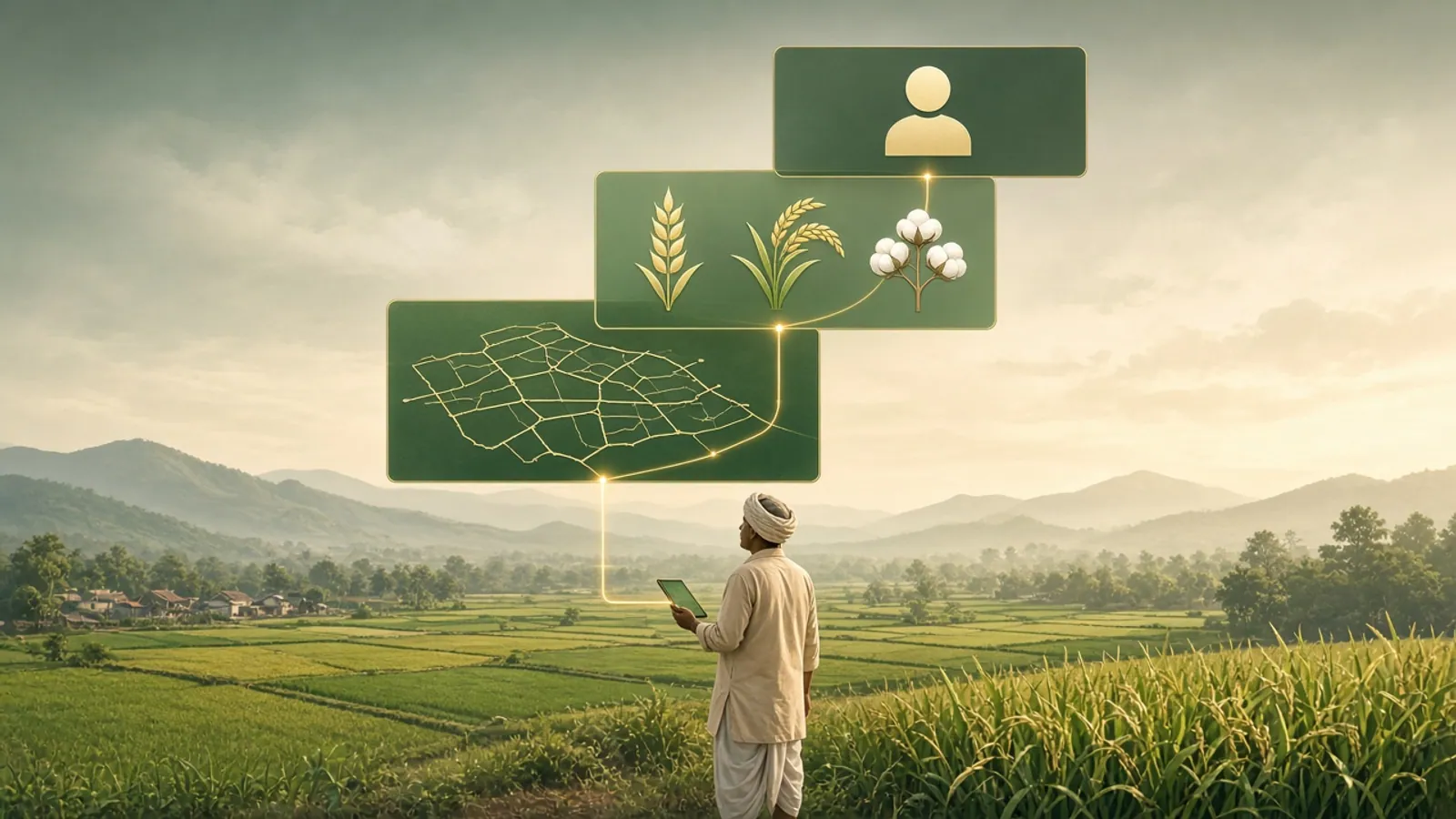
AgriStack is the Government of India’s digital public infrastructure for agriculture. It connects three kinds of records that State Governments maintain: a register of farmers, digital maps of village land, and a season-by-season record of the crops grown on each plot. Together they let government departments, and with the farmer’s consent other service providers, identify a farmer and their land quickly without asking for the same documents again and again.
This guide explains each part in plain language, how the pieces fit together, what has actually been built so far according to official figures, and what it means for you as a farmer. If you only want to register, go straight to our Farmer Registry registration guide or find your state in the state portal directory.
AgriStack = Farmer Registry (who the farmer is) + Geo-Referenced Village Maps (where the land is) + Crop Sown Registry (what is grown, season by season). States build and own these registries. A farmer who registers gets a Farmer ID.
Why the Government built AgriStack
For decades, almost every agricultural scheme in India has asked farmers to prove the same things from scratch: who they are, that they hold land, how much land, and what they grow. Each department kept its own list. A farmer applying for a seed subsidy, crop insurance and a crop loan in the same season might carry the same land papers to three offices.
The national AgriStack website describes the aim directly: to make it easier for farmers to get “cheaper credit, higher-quality farm inputs, localized and specific advice, and more informed and convenient access to markets”, and to make it easier for governments to plan and run farmer schemes. Its stated objectives include:
- improving delivery of government benefits so they reach farmers faster and more easily;
- creating a “presence-less” way to identify and authenticate farmers, so a farmer does not always need to visit an office;
- lowering the cost and risk of agricultural services such as credit, finance and inputs;
- making it easier for central ministries and State Governments to combine schemes.
In August 2026 the Ministry of Agriculture and Farmers Welfare summed it up in Parliament as a “farmer-centric Digital Public Infrastructure (DPI) built as a public good for efficient, easier and faster service and scheme delivery to the farmers”.
Where AgriStack sits in the Digital Agriculture Mission
AgriStack is part of the wider Digital Agriculture Mission. In a Lok Sabha reply on 11 August 2026, the Ministry described AgriStack as “a digital foundation established to leverage data and digital services in the agriculture sector so that various government schemes can reach eligible farmers more quickly and effectively”. States also build their own services on top of it. Maharashtra, for example, told Parliament that it uses AgriStack for loan waiver schemes, the MahaDBT and PoCRA DBT platforms, disaster relief and fertiliser distribution.
The three foundation registries
Official statements consistently describe AgriStack as three foundational registries, “all created and maintained by the State Governments/Union Territories”. Understanding these three is the key to understanding everything else.

1. Farmer Registry
The Farmer Registry is a list of farmers in a state, with each farmer linked to the land they hold in the state’s land records. The national AgriStack website calls it “a federated registry of all the farmers in the country, compiled by States according to common standards”.
Each farmer in the registry receives a unique Farmer ID. AgriStack describes this as “a functional ID, based on Aadhaar” with “a digitally verifiable credential”. The registry keeps only the minimum personal details needed to identify the farmer and work out eligibility for schemes.
The Ministry has said the registry covers landholding farmers, including women farmers, and also records assets such as livestock and fisheries. The registry application also has a provision to onboard cultivators such as tenants and sharecroppers. How far each state has used that provision varies. Our explainer on tenant farmers and the Farmer Registry goes into this.
How the Farmer Registry links to land
The registry does not create new land records. It reads the state’s existing record of rights (RoR), the official land record that goes by names such as khatauni, 7/12, jamabandi or patta in different states. Before registration starts, the state groups the land parcels in each village by owner. The official FAQ calls these groups “buckets”. When a farmer registers, the system shows the land linked to their name and the farmer claims it. Revenue officials then approve the claim.
The official description is careful about one point: the link to land is “for non-legal, planning and advisory, and scheme-delivery purposes only”. In other words, being in the Farmer Registry does not prove or change legal ownership. Legal title still depends on your land records.
What this means if your land record is wrong
Because the registry reads the RoR, a problem in the land record usually becomes a problem in the registry. If land is still recorded in the name of a parent who has died, or a sale has not been mutated, the official FAQ lists these as common reasons for a claim being rejected. The fix generally starts at the revenue office. See land mutation and the Farmer Registry.
2. Geo-Referenced Village Maps
Most Indian villages have cadastral maps: drawings of every plot with its survey number. Many of these maps were drawn on paper decades ago. Geo-referencing means fitting such a map onto real geographic coordinates, so that a plot on the map can be located precisely on the ground, on a satellite image or by a phone’s GPS.
This is what makes the next registry possible. A surveyor standing in a field can only record “this plot has wheat” correctly if the system knows exactly which plot they are standing in. Our article on AgriStack village maps explains geo-referencing in more detail.
3. Crop Sown Registry and the Digital Crop Survey
The Crop Sown Registry records which crop is sown on which plot, every season. The national website describes it as replacing “previously prevalent paper-based methods of surveying crops” with “smartphone and image-based” methods, and notes that drone and satellite imagery may be used in future.
The data comes from the Digital Crop Survey (DCS), in which surveyors visit plots and record the crop with a geo-tagged photo. According to the Ministry:
| Season | Districts covered | Plots surveyed | Source |
|---|---|---|---|
| Kharif 2025 | 604 | more than 28.5 crore | PIB, 10 February 2026 |
| Rabi 2025-26 | 648 | more than 31.3 crore | Lok Sabha reply, 11 August 2026 |
The Ministry says DCS data is being used to produce near real-time crop production estimates. Read more in What is the Digital Crop Survey?.
The central building blocks that connect the registries
States hold the registries, but some shared components are run centrally so that the state systems can talk to each other and to scheme systems. The national website lists:
| Component | What it does, in plain words |
|---|---|
| Unified Farmer Service Interface (UFSI) | A common set of data formats and APIs, so that banks, insurers or departments can request registry data in a standard way, with permission. |
| Consent Manager | Records the farmer’s consent before personal data is shared, and lets that consent be withdrawn. It was designed around the Data Empowerment and Protection Architecture (DEPA). |
| AgriStack Sandbox | A test environment with sample data where approved organisations can try their services before getting access to real systems. |
The design comes from the India Enterprise Architecture (IndEA 2.0) framework of the Ministry of Electronics and Information Technology, which is why AgriStack talks about “federation” and “functional IDs”.
What “federated” means for you
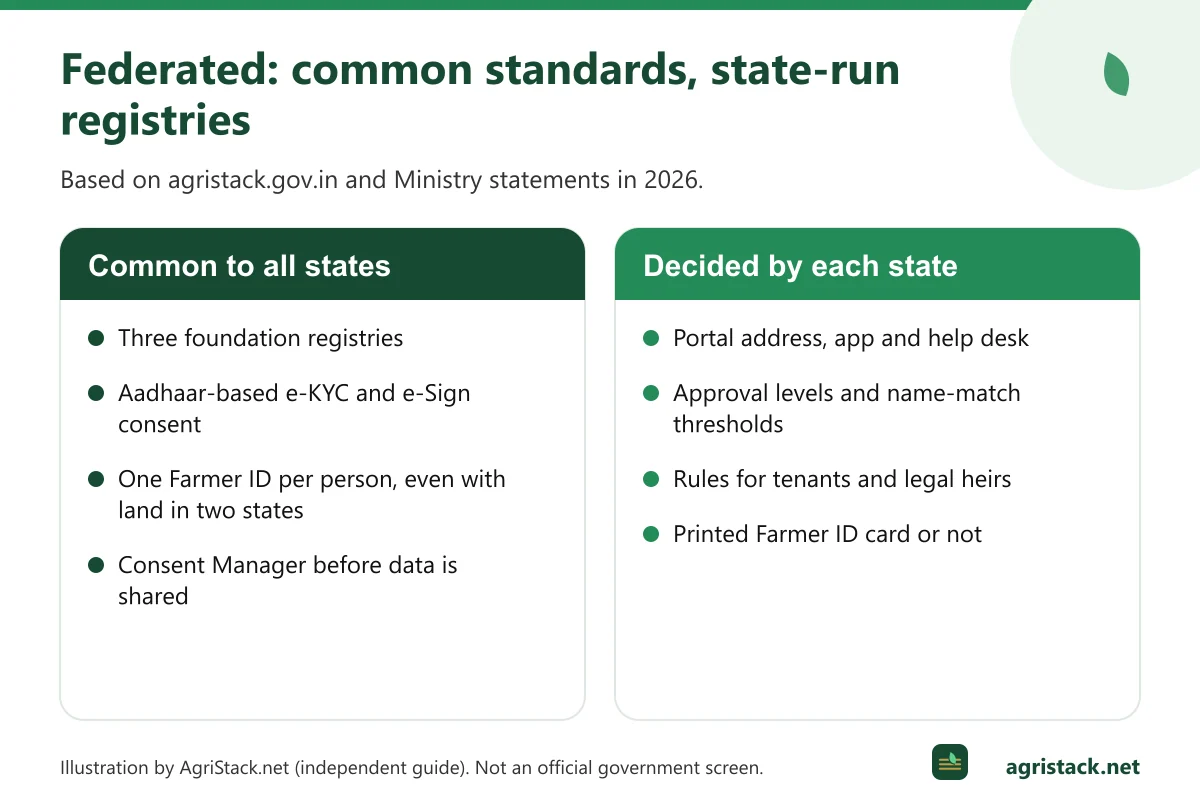
“Federated” means each state compiles and runs its own registry, but all states follow common standards. The national website says the Farmer Registry is “compiled by States according to common standards, and cached by the Centre”. It also notes that states have formed steering committees across their revenue and agriculture departments to oversee implementation. The Ministry stated in August 2026 that “the ownership of the data is with the respective States”.
For a farmer, this has three practical effects:
- You register on your state’s portal, not on a single national form. Every state has its own address, for example
upfr.agristack.gov.infor Uttar Pradesh ormhfr.agristack.gov.infor Maharashtra. - Rules and screens differ slightly between states. States can add their own fields, approval steps and help desks.
- One person, one Farmer ID. The official FAQ says that farmers with land in more than one state still get a single Farmer ID against their Aadhaar.
How a farmer joins: the Farmer ID in brief
Joining AgriStack, for a farmer, means registering in the state Farmer Registry. Based on the official FAQ and state user manuals, the general sequence is:
- Identity check with Aadhaar e-KYC, usually by OTP on the Aadhaar-linked mobile, or biometrics at a centre.
- Land claim: the system shows land parcels linked to your name, or you search by district, sub-district, village and survey number.
- Consent: you agree to be part of AgriStack and to the declarations, typically by Aadhaar-based e-Sign.
- Enrolment number: an enrolment number is sent to your mobile so you can track the claim.
- Approval: state officials verify the claim; if approved, a Farmer ID is generated.
The official FAQ states that the Farmer ID is a random number with a check digit, is valid for life, and is generated within about 24 hours of the claim being approved. Our dedicated guide, What is a Farmer ID?, covers all of this in depth.
You can register yourself on the state portal or app, or get help. The Ministry has said farmers without mobile phones can use Farmer Producer Organisations, Krishi Sakhis and Common Service Centres, and that states are organising camps “so that no farmer is left out”.
What AgriStack is being used for
AgriStack only matters to farmers if it saves them time or money. The Government has listed specific uses in its 2026 statements to Parliament. Depending on the state, the Farmer ID or AgriStack data is being used for:
| Use | What the Government has said |
|---|---|
| PM-KISAN | Accurate targeting of beneficiaries for Direct Benefit Transfer. See Farmer ID and PM-KISAN. |
| Crop insurance (PMFBY) | The Farmer ID is being used for enrolment under the Pradhan Mantri Fasal Bima Yojana. |
| MSP procurement | Procurement through the Food Corporation of India and under the Price Support Scheme of PM-ASHA. |
| Credit | Sanctioning of Kisan Credit Card loans “within half an hour” where integrated, and the Jan Samarth platform. |
| Fertiliser | Booking of fertiliser. |
| Disaster relief | Faster relief payments. |
| Soil Health Cards | Linking to support crop and input planning. |
Two state examples have been cited by the Ministry. In Maharashtra, AgriStack was used for disaster relief including “the transfer of over ₹14,000 crore to 89 lakh farmers for Kharif 2025 crop losses in 5 days”. In Chhattisgarh, Farmer ID and the Digital Crop Survey were used for MSP-based paddy procurement “covering over 32 lakh farmers in a single season”.
That a scheme uses AgriStack does not mean every farmer must have a Farmer ID for it today. Requirements are set scheme by scheme and often state by state, and they change. Confirm on the scheme’s official website or with your agriculture office before you act.
Progress so far: official figures
Registration has grown quickly through 2026. The figures below are the Government’s own, with the date each count refers to:
| As on | Farmer IDs generated | Source |
|---|---|---|
| 4 February 2026 | more than 8.48 crore | PIB release, 10 February 2026 |
| 19 March 2026 | 9,18,69,685 (table total) | PIB release, 24 March 2026 |
| 30 July 2026 | 10,28,25,379 | Lok Sabha reply, 4 August 2026 |
| 6 August 2026 | 10,33,93,603 | Lok Sabha reply, 11 August 2026 |
On 6 August 2026, the state-wise table listed 21 states and union territories, led by Uttar Pradesh, Maharashtra and Madhya Pradesh. The full tables, the change since March, and notes on small inconsistencies in the official documents are on our AgriStack statistics page.
These are counts of Farmer IDs generated, not the total number of farmers. Different states started at different times, and their populations of landholders differ greatly, so a lower count does not by itself mean a state is doing badly.
Privacy and security: what has been promised
A system that links your identity, land and crops naturally raises privacy questions. Here is what official sources say, quoted as closely as possible:
- Consent before sharing. The Ministry says AgriStack was developed in accordance with the Digital Personal Data Protection Act, 2023 and the Digital Personal Data Protection Rules, 2025, so “that farmers’ data is collected only with their consent and farmers have full control over their data for sharing with authorized entities for specific purposes”.
- Aadhaar is not kept in the registry application. The official FAQ says the Farmer Registry application does not store Aadhaar; it is kept in a data vault, and the registry stores a randomly generated Farmer ID.
- No farmer sees another farmer’s data. The FAQ says a farmer can log in with e-KYC to see their own information, and “information of any one Farmer is not visible to other Farmers”.
- Encryption and security standards. The Ministry says AgriStack maintains information in encrypted form and follows MeitY and CERT-In cybersecurity guidelines.
- Consent can be withdrawn. The national website says consent, once given, “may also be revoked, preventing future sharing of data”.
These are commitments made by the Government. An independent website like ours cannot audit the systems behind them. What you can control is where you enter your details. Use only official state portals ending in agristack.gov.in, and never share an OTP with anyone who calls you. Our guide to fake AgriStack websites and apps shows what to watch for.
Common misunderstandings
“AgriStack is a scheme that gives money.” It is not a scheme. It is the infrastructure that schemes use. Getting a Farmer ID does not by itself mean you will receive any payment.
“AgriStack.net is the official site.” It is not. This website is independent. The official national site is agristack.gov.in, and registration happens on state portals.
“Registering will change my land records.” It will not. The registry reads land records. If you need to change a land record, you go through your state’s mutation or correction process.
“I need to pay an agent to register.” Self-registration on official portals does not require paying an agent. If you use a Common Service Centre, ask about any service charge before you begin, and never hand over your OTP to anyone except the system you are using in front of you.
“Every state works exactly the same way.” The core design is shared, but each state runs its own registry and can customise it. Karnataka, for example, has had its own FRUITS farmer database for years. See our Karnataka guide.
What to do next
- If you have not registered: read Farmer Registry online registration and prepare your documents.
- If you need your state’s portal: open the state-wise portal directory.
- If you have registered and are waiting: see the approval process and status check guide.
- If something went wrong: browse errors and solutions.