The Farmer ID is mandatory for new PM-KISAN registrations in states where the Farmer Registry has started. In March 2026, the Ministry told Parliament: “The Farmer ID has been made mandatory for only new registrations under PM-KISAN in 19 States where farmer registry work has been commenced. In the States where the farmer registry work has not yet started, farmers can register without Farmer ID.”
That statement is about new registrations. It does not say that existing PM-KISAN beneficiaries lose their instalments without a Farmer ID. This guide explains how the two connect, what is confirmed, and what to do in each situation.
- PM-KISAN is a scheme. It pays eligible farmer families ₹6,000 a year in three instalments.
- Farmer ID is an identity. It links you to your land in your state’s Farmer Registry and is used by many schemes, including PM-KISAN.
What you should do

| Your situation | What the official sources say | What to do |
|---|---|---|
| New PM-KISAN applicant, Farmer Registry running in your state | Farmer ID mandatory for new registration | Get your Farmer ID first, then apply for PM-KISAN |
| New PM-KISAN applicant, Farmer Registry not started | Can register without Farmer ID | Apply on the PM-KISAN portal; register for a Farmer ID when your state opens |
| Existing PM-KISAN beneficiary | March 2026 statement covers new registrations only | Check your status and e-KYC on the PM-KISAN portal; get a Farmer ID anyway |
| Farmer ID rejected or pending | New PM-KISAN registration may wait | Fix the cause; see application rejected |
To find out whether your state’s Farmer Registry is running, see state-wise portals.
PM-KISAN in brief
From the March 2026 Parliament reply:
- PM-KISAN is “a central sector scheme launched in February 2019”.
- “a financial benefit of ₹ 6,000/- per year is transferred in three equal instalments, into the Aadhaar seeded bank accounts of farmers through Direct Benefit Transfer (DBT) mode”.
- “cultivable landholding is primary eligibility criteria to receive benefit of the Scheme subject to certain exclusions relating to higher economic status”.
- Over ₹4.09 lakh crore had been disbursed “through 21 installments since inception”.
How Farmer ID and PM-KISAN connect
Both depend on land
PM-KISAN’s main test is cultivable landholding. The Farmer Registry is built from the land record. So both need your land to be recorded in your name.
The registry used PM-KISAN data to start
The official FAQ says that, while preparing the registry, land “buckets” were linked with Aadhaar “using data from PMK and PMFBY (provided by the Centre) and any State DBT/Scheme database as decided by the State”. This is one reason some farmers see their land already grouped when they register.
The land record wins
If PM-KISAN shows land that the land record does not, the FAQ says: “The farmer registry is to be built strictly as per ROR data. The variations in PMK would have to be handled and justified by the state government.”
PM-KISAN now uses Farmer IDs
The Ministry told Parliament in August 2026 that the Farmer Registry “is being integrated with various farmer-centric schemes and digital platforms, including PM-KISAN”. A separate August 2026 reply said AgriStack supports “accurate targeting of beneficiaries for Direct Benefit Transfer (DBT) under PM-KISAN”.
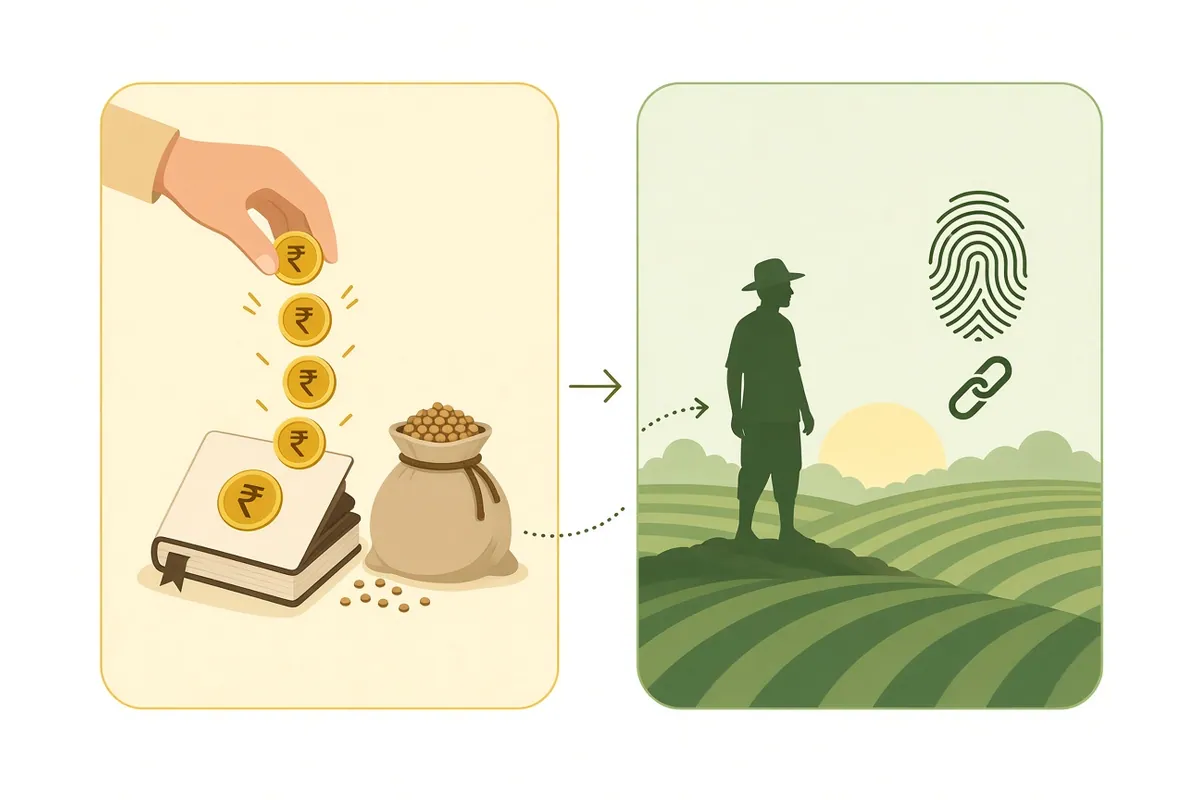
Farmer ID vs PM-KISAN at a glance
| Farmer ID | PM-KISAN | |
|---|---|---|
| What it is | Digital identity for a farmer | Income support scheme |
| What you get | An ID linked to your land | ₹6,000 a year in three instalments |
| Based on | Aadhaar and the state land record | Cultivable landholding, with exclusions |
| Where you apply | Your state’s Farmer Registry portal | PM-KISAN portal, CSC or agriculture office |
| Run by | State governments | Central government (central sector scheme) |
| Income-based exclusions | None mentioned in official sources | Yes (see below) |
| Covers | Individual farmers | Farmer families |
Who PM-KISAN excludes
You can have a Farmer ID and still be outside PM-KISAN. According to the PM-KISAN operational guidelines, the scheme excludes:
- Institutional landholders.
- Families where any member is or was a constitutional post holder; is or was a Minister, MP, MLA, MLC, mayor or district panchayat chairperson; or is a serving or retired officer or employee of central or state government, a PSU or a local body (except Multi Tasking Staff, Class IV and Group D employees).
- Pensioners receiving ₹10,000 or more a month (with the same exceptions).
- Income tax payers in the last assessment year.
- Registered practising professionals such as doctors, engineers, lawyers, chartered accountants and architects.
- Non-resident Indians (NRIs), for new beneficiaries, as defined under the Income Tax Act, 1961.
For PM-KISAN, a family means husband, wife and minor children. Check the PM-KISAN portal for the full and current rules.
Families and individuals
PM-KISAN pays benefits to a farmer family. The Farmer ID belongs to an individual. In a family where both husband and wife own land, each can have a Farmer ID, but PM-KISAN’s family rules still decide how the benefit is paid. A Farmer ID for each family member does not multiply PM-KISAN payments.
Land records: the common rule
PM-KISAN’s operational guidelines say: “The benefit shall be paid to only those farmers’ families whose names are entered into the land records. Exception has, however, been made for North-East States and Jharkhand in this regard.” The Farmer Registry also follows the land record. So for most farmers, the same fix (getting land recorded correctly in your name) helps with both.
Self-declaration and recovery
Under PM-KISAN, states certify beneficiaries on the basis of self-declaration, and benefits paid on the basis of an incorrect declaration can be recovered. A Farmer ID does not change this. If you fall in an excluded category, getting a Farmer ID does not make you eligible for PM-KISAN.
What each system holds about you
The two systems collect different information, which is another reason they are kept separate.
| Information | PM-KISAN database | Farmer Registry (UP self mode) |
|---|---|---|
| Name, Aadhaar | Yes | Yes (Aadhaar kept in a data vault) |
| Age, gender, category | Yes | Name and details fetched from Aadhaar |
| Bank account and IFSC | Yes, for payments | No bank step in the UP self-mode flow |
| Mobile number | Yes | Yes, verified by OTP |
| Land details | Yes, from land records | Yes, linked plot by plot to Farm IDs |
| Family members | Family as a unit | Each person separately |
The PM-KISAN column is from paragraph 6.1 of the operational guidelines, which says states prepare a database “capturing the Name, Age, Gender, Category (SC/ST), Aadhaar Number, Bank Account Number and the Mobile Number of the beneficiaries”. The Farmer Registry column is from the national FAQ and the Uttar Pradesh manual.
Because bank details sit with PM-KISAN, payment problems (wrong account, Aadhaar not seeded with the bank) are fixed through PM-KISAN and your bank, not through the Farmer Registry.
If your state has not started the Farmer Registry
The March 2026 statement is clear: “In the States where the farmer registry work has not yet started, farmers can register without Farmer ID.” You can apply for PM-KISAN in the usual way. When your state opens the registry, register for a Farmer ID as well, because other schemes in your state may start using it.
PM-KISAN e-KYC is separate
The PM-KISAN portal says: “eKYC is MANDATORY for PMKISAN Registered Farmers. OTP Based eKYC is available on PMKISAN Portal or nearest CSC centres may be contacted for Biometric based eKYC.”
Completing PM-KISAN e-KYC does not register you in the Farmer Registry, and getting a Farmer ID does not complete your PM-KISAN e-KYC. If you are a PM-KISAN beneficiary, do both.
About the “19th instalment” claim
In early 2025, some websites said a Farmer ID was mandatory for the 19th PM-KISAN instalment. We have not found an official source confirming that. The official position we found, from March 2026, applies to new registrations in states where the registry has started.
If you read a claim like this, check the date and look for a link to PIB, the PM-KISAN portal or a state government order.
Step by step for a new PM-KISAN applicant
- Check whether your state's Farmer Registry is running on our state portals page.
- Register for a Farmer ID on the state portal, at a CSC or at a camp. See online registration.
- Wait for approval. Track it with your enrolment number. See approval process.
- Apply for PM-KISAN through the official PM-KISAN portal, a CSC or your agriculture office.
- Complete PM-KISAN e-KYC as the PM-KISAN portal requires.
Common problems
“My Farmer ID is pending, so I cannot apply for PM-KISAN”
In states where the Farmer ID is mandatory for new registration, you may need to wait. See status pending.
“My name is different in PM-KISAN and the land record”
The Ministry said in March 2026: “a grievance mechanism is in place through which farmers can raise issues related to land or name mismatch which enables them to register for Farmer ID”. See name mismatch.
“I do not have a mobile phone”
The same reply says farmers without mobile phones can use “Common Service Centres (CSCs) and state government offices at Block and Tehsil level”.
“My land is still in my father’s name”
Neither PM-KISAN nor the Farmer Registry can link land that is not recorded in your name. Get the mutation done first. See inherited land.
Other schemes that use the Farmer ID
The March 2026 reply says the Farmer ID “enables seamless integration of Direct Benefit Transfer (DBT) schemes such as registrations under” PM-KISAN, PMFBY (crop insurance), “Minimum Support Price (MSP) based procurement, access to credit delivery, input distribution, and disaster relief”. So a Farmer ID is useful even if you are not eligible for PM-KISAN.
State examples from Parliament
The same reply gave two examples:
- Maharashtra used AgriStack for disaster relief, “including the transfer of over ₹14,000 crore to 89 lakh farmers for Kharif 2025 crop losses in 5 days”.
- Chhattisgarh “has institutionalized Farmer ID and Digital Crop Survey for MSP-based paddy procurement, covering over 32 lakh farmers in a single season”.
The August 2026 reply on the Digital Agriculture Mission also lists uses such as MSP procurement through the Food Corporation of India, fertilizer booking, disaster relief, Kisan Credit Card loans, crop insurance enrolment and Soil Health Cards.
The numbers so far
| Figure | Value | Source |
|---|---|---|
| PM-KISAN money disbursed | Over ₹4.09 lakh crore in 21 instalments | PIB, 10 March 2026 |
| States where Farmer ID is mandatory for new PM-KISAN registration | 19 | PIB, 10 March 2026 |
| Farmer IDs generated | More than 10.33 crore as of 6 August 2026 | Lok Sabha reply, 11 August 2026 |
For state-wise Farmer ID figures, see AgriStack statistics.
How to check your PM-KISAN status
Use the official PM-KISAN portal at pmkisan.gov.in. It has a “Know Your Status” option for beneficiaries. Your Farmer Registry status is checked separately, on your state’s Farmer Registry portal. See Farmer Registry status check.
Watch out for fraud
- The official sources we reviewed mention no fee for self-registration. Be wary of anyone charging to “link” a Farmer ID to PM-KISAN.
- Never share an OTP with callers who say they are from PM-KISAN or AgriStack.
- See fake websites and apps.