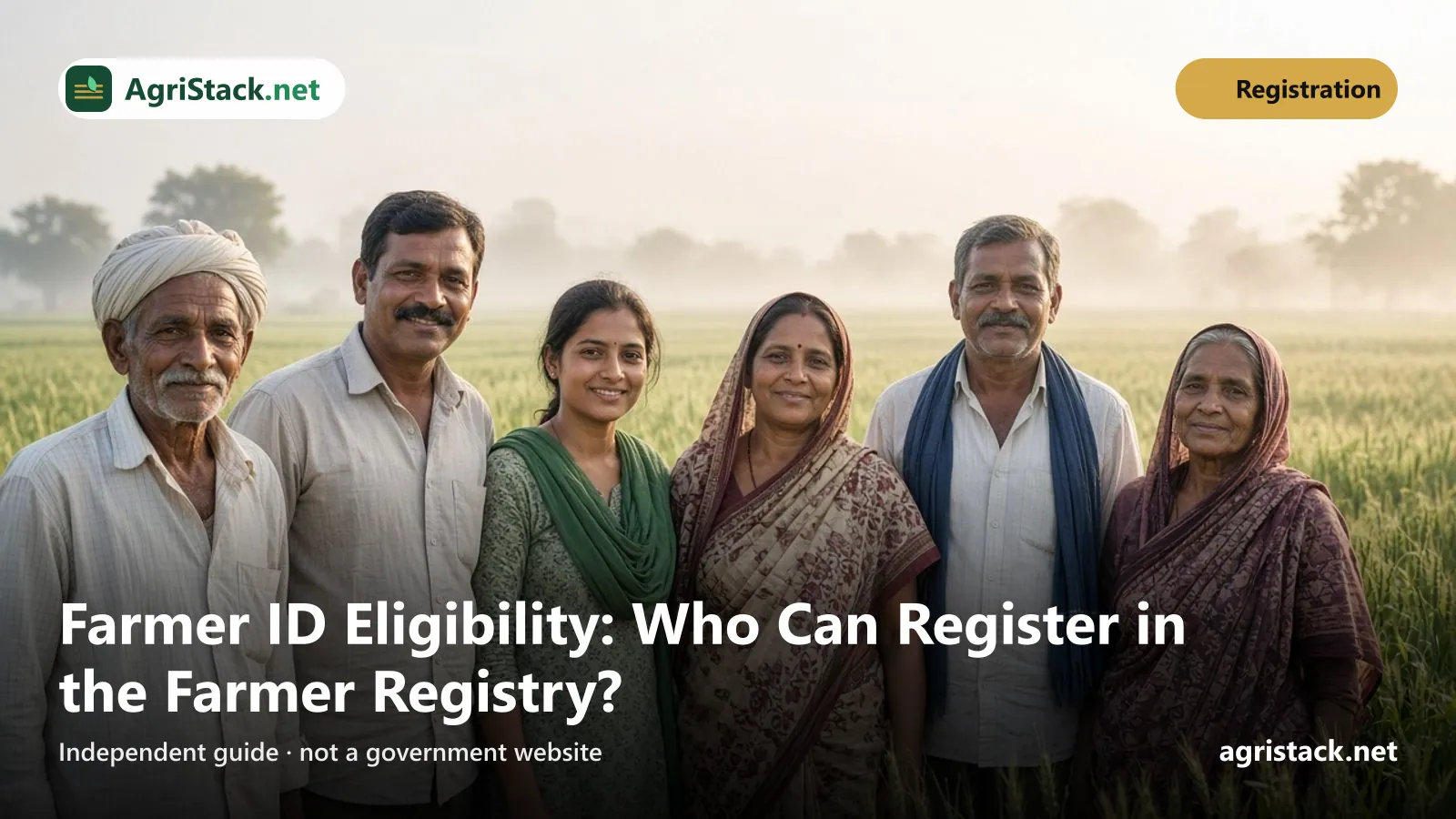
You are eligible for a Farmer ID if your name is in your state’s digital land record for agricultural land and you have an Aadhaar number. This includes women and joint owners. The Ministry says the registry also has a provision for cultivators such as tenants and sharecroppers, but whether they are included is decided by each state.
Eligibility is mostly about your land record, not about your income, caste or the size of your farm. This guide goes through each type of farmer, says what the official sources confirm, and flags where your state decides.
In March 2026, the Ministry told Parliament: “The State Farmers Registry under the AgriStack DPI covers all the landholding farmers, including women farmers, livestock and fisheries and provides them a digital identity called Farmer ID. The Farmers Registry application also has the provision to onboard all the landholding farmers, as well as cultivators such as tenants & sharecroppers.”
The quick eligibility test
Answer these four questions:
- Is your name in the current land record (khatauni, 7/12, jamabandi, pahani, or your state’s equivalent)?
- Is that land classified as agricultural land?
- Do you have an Aadhaar number?
- Has the Farmer Registry started in your state?
If all four are “yes”, you can register. If the first is “no”, read the sections on heirs, buyers, tenants and cultivators below.

Why the land record decides
The Farmer ID is created by linking you to your land. The Ministry told Parliament in August 2026 that a “Farmer ID is created by synchronizing farmers’ details with their digitized land records”. The official FAQ says the registry follows the current owner in the record of rights, and that it “will consume only those farm ids which are classified as agriculture land”.
So the question is not “Am I a farmer?” but “Does the land record show me as the owner of agricultural land?”
Eligibility by type of farmer
| Your situation | Eligible? | What the sources say |
|---|---|---|
| Sole owner in the land record | Yes | Registry links land to the owner in the record |
| Woman owner or co-owner | Yes | Covers “all the landholding farmers, including women farmers” |
| Joint owner (several names on one plot) | Yes, each owner | Each co-owner is linked to the same Farm ID |
| Heir; land still in late parent’s name | Usually not yet | Mutation first, unless the state brings heirs in earlier |
| Buyer; record still shows seller | Not yet | Mutation first |
| Tenant or lessee | State decides | Provision exists; inclusion “as per the State policy” |
| Sharecropper | State decides | Named as a cultivator the application can onboard |
| Forest Rights Act holder | In some states | Maharashtra has registered FRA holders |
| Livestock or fisheries farmer | See below | Registry “covers … livestock and fisheries” |
| Landless agricultural labourer | Not confirmed | Not mentioned in the sources reviewed |
| Owner of non-agricultural land only | No | Registry uses agricultural land only |
Landowners
If you are the recorded owner, you are eligible. Our online registration guide explains the steps.
Women farmers
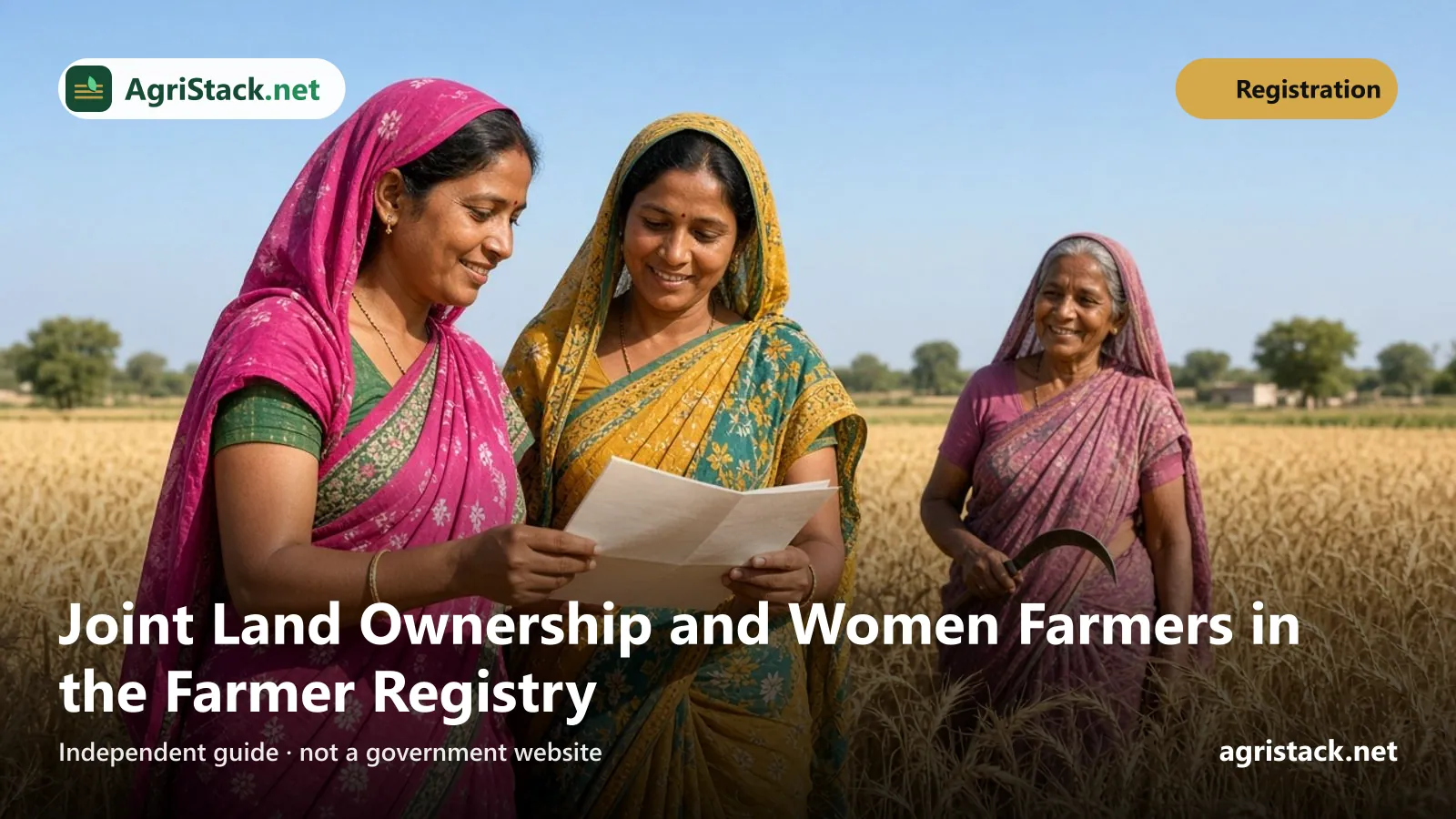
The Ministry’s February 2025 reply says the Farmer Database “will cover all the land holders’ farmers, including women farmers”. A woman whose name is in the record registers with her own Aadhaar and mobile. See joint land and women farmers.
Joint owners
Where several people own one plot, the FAQ explains that one Farm ID is created and “All six owners will be assigned same farm id” in its example. Each owner registers separately and claims their share of the same plot.
Heirs of a deceased owner
The FAQ says the Farm ID stays with “the CURRENT owner as per ROR”. The Ministry told Parliament that land records for “inheritance and land transactions are updated by the respective State Governments”. You become eligible for that land once the succession mutation is recorded. The FAQ also says a state “can decide whether they would like to bring legal heirs in farmers registry pending updating to ROR”, so ask whether your state does this. See inherited land.
Buyers awaiting mutation
Same rule: until the record shows your name, you cannot claim the land. See land mutation.
Tenants, lessees and sharecroppers
The Ministry’s February 2025 reply says: “Farmers Registry application has the provision to onboard the tenant and lessee farmers. State can decide to include such farmers in the Farmers Registry as per the State policy.” The March 2026 reply names “cultivators such as tenants & sharecroppers”.
The FAQ also describes a separate route: owners can “Authorize a beneficiary at Scheme level” so that cultivators get benefits “without having a need to declare tenancy”. See tenant farmers.
Forest Rights Act holders
In August 2026, the Ministry told Parliament that for “farmers covered under the Forest Rights Act, 2006”, Maharashtra had registered “a total of 22,597 Forest Rights holder farmers” as of 4 August 2026. Other states were not named in that reply.
Livestock and fisheries farmers
The March 2026 reply says the registry covers “livestock and fisheries”. A separate August 2026 reply says AgriStack provides a profile including “assets such as livestock and fisheries”. What these replies do not explain is whether a livestock or fisheries farmer without land can get a Farmer ID, or what the state process is. Until a state publishes that, treat it as unconfirmed. We cover this in livestock and fisheries farmers.
Landless agricultural labourers
The official sources reviewed for this guide mention landholding farmers and cultivators such as tenants and sharecroppers. They do not mention landless labourers. Ask your state agriculture department.
What you need to be eligible in practice
| Requirement | Why |
|---|---|
| Aadhaar number | The Farmer ID is created against your Aadhaar |
| Aadhaar-linked mobile (or help from a CSC or camp) | OTPs for sign-up and e-Sign |
| Name in the current land record | The registry follows the record |
| Agricultural land classification | Only agricultural Farm IDs are used |
| Registry running in your state | Registration happens on state portals |
The full list is in documents required.
Farmers without a mobile phone
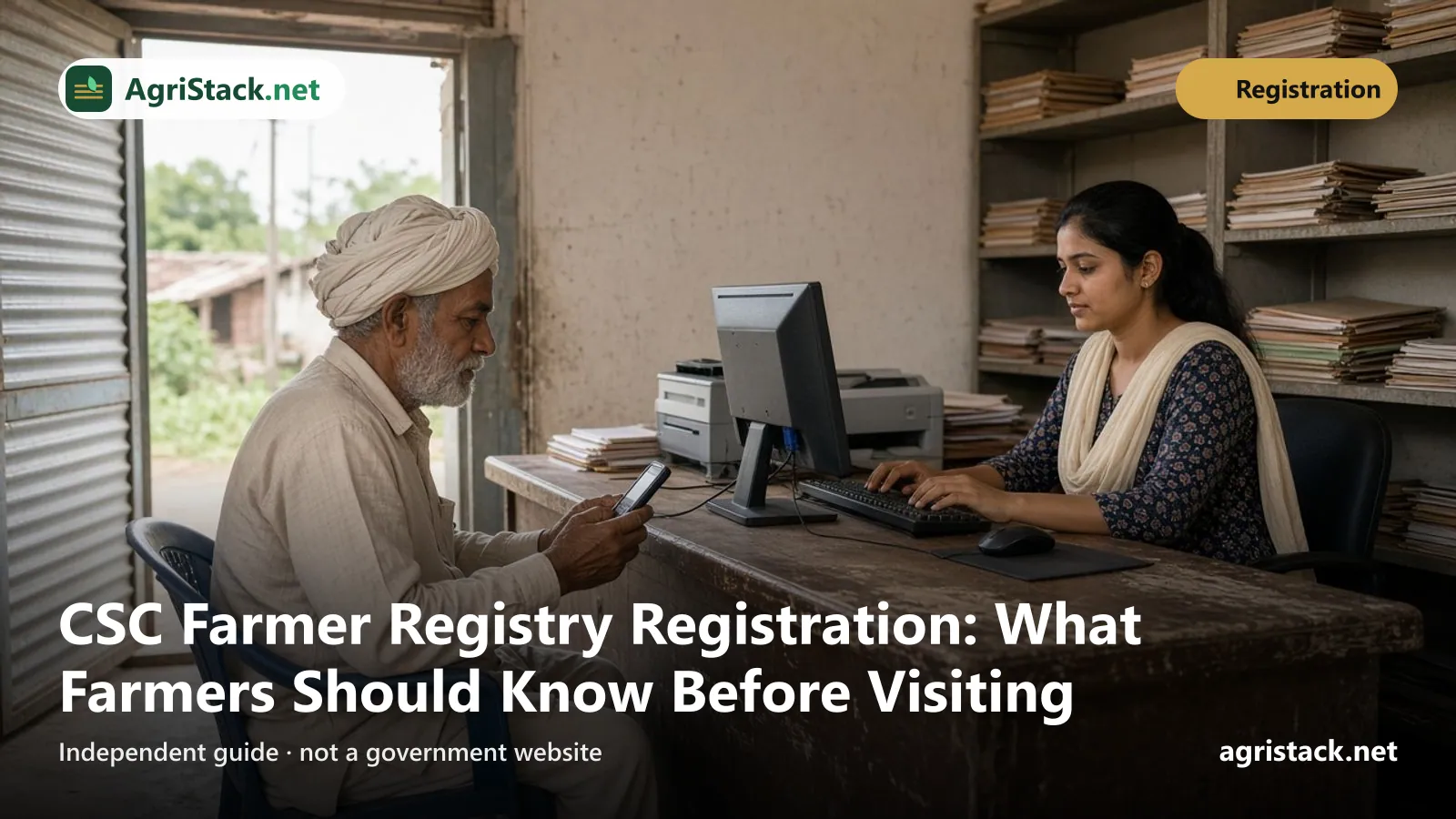
You are still eligible. The March 2026 reply says such farmers “can use existing support structures like Farmer-Producer Organisations (FPOs), KrishiSakhis, and Common Service Centres (CSCs) to get them registered”, and that “States are organizing the camps”.
Has your state started?
Registration happens on state portals. The March 2026 reply listed Farmer IDs generated in 19 states as of 19 March 2026. The August 2026 replies reported over 10 crore Farmer IDs. Check state-wise portals for the official link for your state, and AgriStack statistics for the latest official numbers.
Land in more than one state or village
You do not need more than one Farmer ID. The FAQ says “Farmers with lands in multiple states get a single Farmer ID against their Aadhaar”. You claim land on each state’s portal. See multiple land plots.
Farmer ID eligibility is not scheme eligibility
A Farmer ID identifies you and your land. It does not automatically make you eligible for every scheme. Each scheme has its own rules.
Example: PM-KISAN
PM-KISAN uses cultivable landholding as its main test but excludes some groups. According to the PM-KISAN operational guidelines, exclusions include institutional landholders, families where a member is a serving or retired government employee (with exceptions for Multi Tasking Staff, Class IV and Group D employees), pensioners receiving ₹10,000 or more a month (with the same exceptions), people who paid income tax in the last assessment year, and registered practising professionals such as doctors, engineers, lawyers, chartered accountants and architects. Constitutional post holders and elected representatives are also excluded.
So a farmer can be eligible for a Farmer ID but not for PM-KISAN. See Farmer ID and PM-KISAN.
How long a Farmer ID lasts
The FAQ says: “There is no validity of farmer ID. Once it is generated, it is for the lifetime to the farmer.” It adds that “The farmer ID would be inactivated after the farmer dies”, and the land then links to the successor.
What a Farmer ID is not
The FAQ says the registry “is not a legal registry for the ownership purpose and it is only for the purpose of services and benefits”. Getting a Farmer ID does not prove ownership, and not having one does not take away ownership.
Six real-life situations
These examples use made-up names to show how the rules apply.
Sunita: co-owner with her brothers
Sunita’s name is in the land record with her two brothers. She is a landholder, so she is eligible. She registers with her own Aadhaar and mobile. Her brothers register separately. All three may be linked to the same Farm ID for the shared plot.
Ramesh: farms leased land
Ramesh owns no land and cultivates a neighbour’s field on lease. His eligibility depends on whether his state includes tenants. He asks the district agriculture office. If the state does not include tenants, the owner may still be able to authorise him as the beneficiary for a particular scheme.
Anil: land still in his late father’s name
Anil cannot claim the land in the normal way yet, unless his state has a process to bring heirs in before mutation. He applies for succession mutation. Once the record shows Anil and his siblings, each of them can register.
Meena: land in two states
Meena owns land in Madhya Pradesh and Rajasthan. She registers on each state’s portal for that state’s land, and gets one Farmer ID against her Aadhaar.
Prakash: retired government employee with farmland
Prakash owns farmland and is eligible for a Farmer ID. But PM-KISAN excludes retired government employees (with some exceptions), so he may not get PM-KISAN. The Farmer ID can still be used for other services.
Lakshmi: raises goats, owns no land
The official replies say the registry covers “livestock and fisheries”, but they do not explain how a landless livestock farmer registers. Lakshmi should ask her state animal husbandry or agriculture office, and not pay anyone who claims to have a special route.
Questions to ask your state agriculture office
If your situation is not a simple “my name is in the land record” case, these questions get clear answers quickly:
- Has the Farmer Registry opened in my district?
- Does our state include tenant farmers, lessees or sharecroppers? If so, what proof is accepted?
- Can an owner authorise a cultivator as a scheme beneficiary here?
- How do heirs register while mutation is pending?
- Are Forest Rights Act holders being registered in our state?
- Is there a process for livestock or fisheries farmers without land?
Write down the name of the office and the date, so you can refer back to the answer.
Common misunderstandings
- “Only small farmers can apply.” The sources do not set a land-size limit for the Farmer ID.
- “I need a caste or income certificate.” Neither is mentioned in the official sources.
- “My son can register on my land.” Only the recorded owner can claim land, unless your state allows other routes.
- “Agents can make anyone eligible.” Eligibility comes from the land record. No one can bypass it.
If you are not eligible yet
- Find out why. Is the land in someone else's name, or not agricultural?
- Visit the revenue office if mutation or correction is needed.
- Ask your agriculture office about tenant, sharecropper or other routes in your state.
- Register once your record is updated.