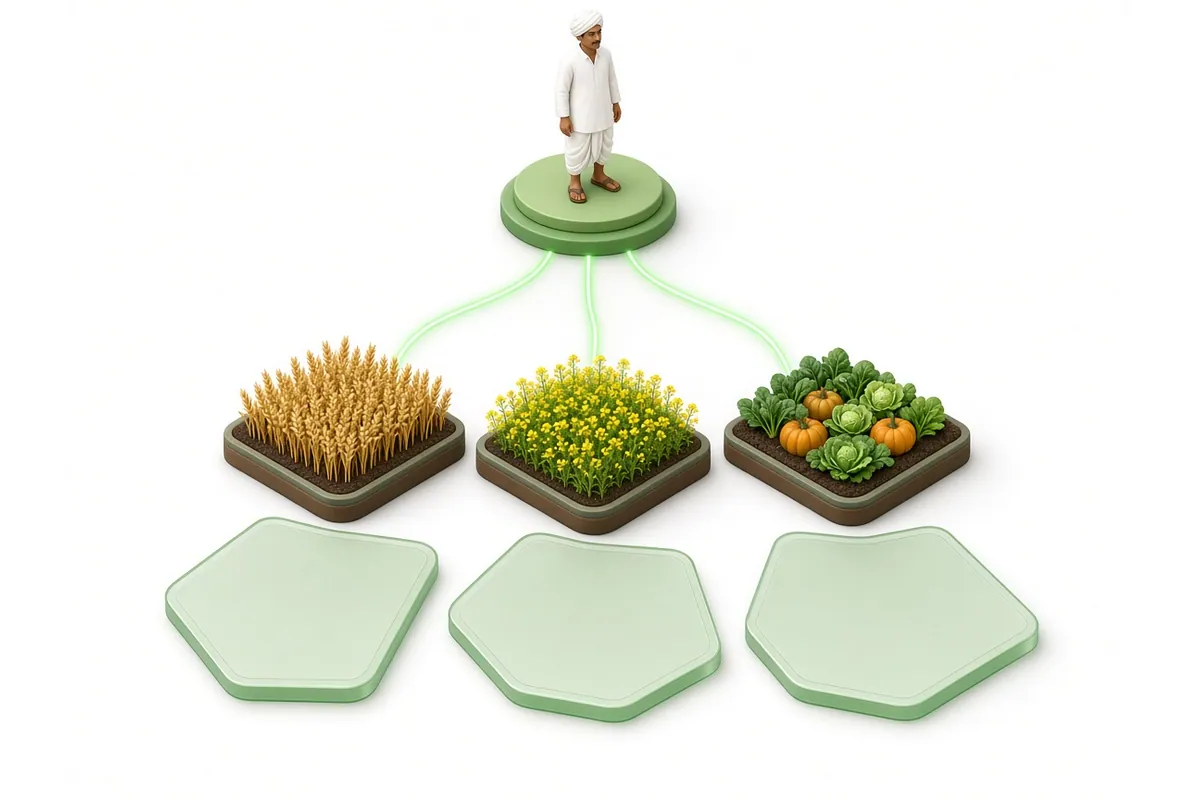
A Farmer ID is for a person, a Land ID is for a plot of land, and a Farm ID is for one ownership share within that plot. You, the farmer, get one Farmer ID against your Aadhaar. Your land may have many Farm IDs, one for each plot where your name appears. Land IDs come from the land record: village code plus survey and sub-survey number.
Most farmers only need their Farmer ID. Understanding the other two helps when a plot is missing, when land is shared, or when someone mentions an ID you have never seen.
- Farmer ID: who you are. One per person, created against Aadhaar.
- Land ID: which plot. Village code + survey number + sub-survey number.
- Farm ID: which ownership share in that plot. Created by the state land record system.
The three IDs side by side
| Farmer ID | Farm ID | Land ID | |
|---|---|---|---|
| Identifies | A person | One ownership’s extent in a plot | A land parcel |
| Created by | Farmer Registry, after your claim is approved | State land record system | State land record (existing numbers) |
| Based on | Aadhaar | Ownership in the record of rights | Village code, survey, sub-survey number |
| Format | 10 digits + 1 check digit | 2-letter state code + 11 digits + 1 check digit | Village code + survey numbers |
| How many per farmer | One, across all states | One per plot where your name appears | As many as your plots |
| Do you use it? | Yes | Rarely | When claiming land |
Farmer ID: the person
What it is
The Farmer ID is your identity in the Farmer Registry. AgriStack describes it as a digital identity for farmers, and the Ministry told Parliament in August 2026 that a “Farmer ID is created by synchronizing farmers’ details with their digitized land records”.
Format
The FAQ says: “It is a 10 digit random number followed by a 1 digit checksum”. Elsewhere it calls it a “randomly generated eleven digit Farmer ID”. Both describe the same 11-digit number.
How many you get
One. The FAQ says “Farmers with lands in multiple states get a single Farmer ID against their Aadhaar.”
How long it lasts
“There is no validity of farmer ID. Once it is generated, it is for the lifetime to the farmer.” It is inactivated when the farmer dies.
Land ID: the plot
What it is
The FAQ lists the Land ID as “Village code, survey number, sub-survey number”. It is the plot’s address in the land record. The FAQ calls this the Plot ID too: “Plot ID is the id of land as in ROR like Khasra no, survey number or gata number.”
Where you see it
When you claim land that does not show up automatically, you enter the district, sub-district, village, survey number and sub-survey number. That is the Land ID in practice. See survey numbers explained.
Farm ID: the ownership share
What it is
The FAQ explains that Farm ID, Farmland Plot ID and Owner Plot ID “represent the extent owned by a single ownership in a particular land parcel and are used interchangeably”. They are “ids within the survey number even though they are unique across the country”.
In plain words: if a plot is split among owners with separate shares, each share gets its own Farm ID.
Format
“Farm ID is a 14 character String. The first two characters denote the State; the remaining is a numeric string of 11 digit random number and 1 digit verheoff checksum (ex: OD234567890123).” The state letters keep Farm IDs unique across states.
Who creates it
The state’s land record system. The FAQ says that for creating Farm IDs “there are no other users except the technical staff under the purview of State revenue department”. Farmers do not apply for Farm IDs.
A common mistake
The FAQ warns that the owner plot ID “should not be construed as common id for all the plots owned by a particular farmer”. A Farm ID is per plot, not per farmer.
What goes into a Farm ID
The FAQ lists the information the state’s system uses to create Farm IDs:
| Field | What it means |
|---|---|
| Land ID | Village code, survey number, sub-survey number |
| Owner’s name | As written in the record |
| Identifier’s name | Father’s, husband’s or guardian’s name |
| Relationship | Between the owner and the identifier |
| Total extent | Area of the whole land parcel |
| Extent owned | Area against this owner |
| Single or joint | Whether ownership is shared |
| Grouping | For joint owners, the main owner number or khata number |
The FAQ also lists basic checks: an owner must have a “Non zero extent”, and in joint ownership “at least one owner in a joint ownership should have extent more than 0”. This is why the area recorded against your name matters.
Worked example: survey number 121/1
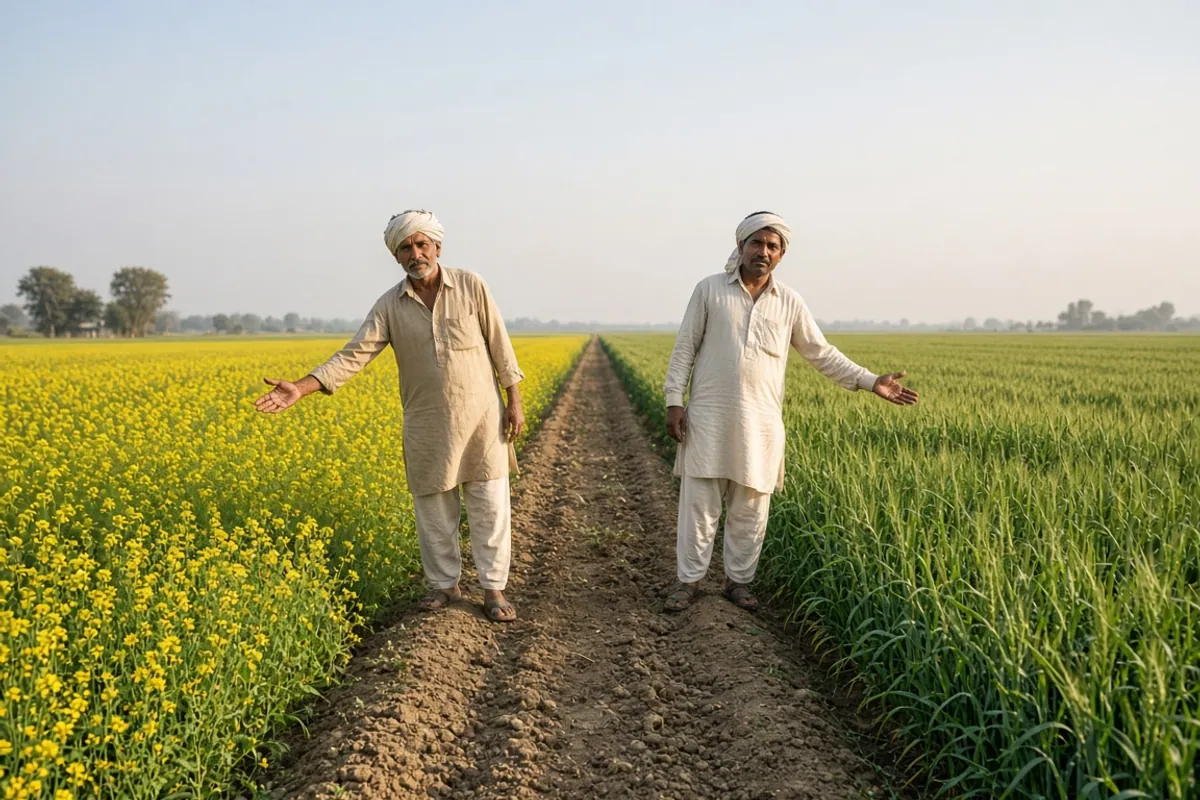
The FAQ uses a 5-hectare plot, survey number 121/1, with six owners, A to F. How many Farm IDs are created depends on how the record shows ownership.
| How the record shows the six owners | Farm IDs created |
|---|---|
| Each has a separate area (A 1 ha, B 1.5 ha, and so on) | 6, one per owner |
| All hold the whole plot jointly | 1, shared by all six |
| A, B, C jointly; D alone; E, F jointly | 3: one for A–C, one for D, one for E–F |
In every case there is one Land ID (121/1). Each of the six owners still has only one Farmer ID.
Example: one farmer with several plots
Suppose Rekha owns three plots: two in her village and one in a neighbouring village.
- Farmer ID: 1 (Rekha’s).
- Land IDs: 3 (one per plot).
- Farm IDs: at least 3. The FAQ says “There would be one Farm ID for each of his name occurring in various plots”.
If Rekha’s plots are spread across two states, she still has one Farmer ID. See multiple land plots.
Other IDs you may hear about
Enrolment ID (draft Farmer ID)
When you claim land and e-Sign, you get an enrolment number. The FAQ says this is the same as the “Draft Farmer ID”, and its structure is “Statecode-Districtcode-VillageCode-running serial number with zero padding”. It is used to track your application and “is relevant till farmer id is created”.
The FAQ is clear that the draft ID does not turn into your Farmer ID: “Final Farmer ID is created separately against an Aadhaar.”
Bucket ID (temporary Farmer ID)
Before registration, the system groups land with the same owner and father’s or husband’s name in a village into a “bucket”. The FAQ says “Temporary Farmer ID and Bucket ID are the same; both of these are internal ids used by software but not required by Farmer.”
Quick comparison
| ID | Who uses it | When |
|---|---|---|
| Bucket ID / Temporary ID | Software only | Before registration |
| Enrolment ID / Draft ID | You, to track status | After claim, before approval |
| Farmer ID | You, for schemes | After approval, for life |
| Farm ID | Land record system | Always, in the background |
See approval process for how an enrolment number becomes a Farmer ID.
The IDs in the order you meet them
- Land IDs and Farm IDs already exist in the state land record system before you register.
- Buckets group your plots in each village. You may see your land listed when you start.
- You claim your land and e-Sign. You get an enrolment number by SMS.
- An official approves your claim, or it is approved automatically.
- Your Farmer ID is created against your Aadhaar. The FAQ says this takes “24 hours” after a claim made at a camp.
- You use your Farmer ID for schemes. Your Farm IDs are linked to it in the background.
How the Farmer ID is meant to be used
The FAQ describes the plan: “It is planned that the farmer ID would be used like Aadhaar for all farmer related services provided by the Govt. or by others in the private sector.” Its example is crop insurance, where the farmer would give the Farmer ID, be authenticated, and have land data “automatically get populated”.
This describes a planned design, not a promise that every service already works this way. In August 2026, the Ministry told Parliament that the Farmer Registry “is being integrated with various farmer-centric schemes and digital platforms, including PM-KISAN, the Jan Samarth platform for Kisan Credit Card (KCC) loans, and MSP-based crop procurement systems”. See Farmer ID and PM-KISAN.
What happens when land changes
Mutation
The FAQ answers “Does mutation of land affects already created Farm ID?” with “Yes”. It also says that if a mutation happens after you claim, “such lands would automatically move from one farmer to another farmer” where the state has connected the registry to the land record.
Death of a farmer
“The farmer ID would be inactivated after the farmer dies. The farm ID would remain the same and would now be linked to the successor of the dead farmer.”
Partition
“If multiple people get portion of the land then the farm ID will be inactivated and multiple farm IDs would be generated depending upon the number of pieces of land created by the family.”
| Event | Farmer ID | Farm ID |
|---|---|---|
| You buy more land | Same | The plot’s Farm ID moves to you after mutation |
| You sell a plot | Same | That Farm ID moves to the buyer after mutation |
| Farmer dies | Inactivated | Same; linked to the successor |
| Land divided among heirs | Each heir has their own | Old Farm ID inactivated; new ones created |
Why the difference matters
- Missing plot? The Farm ID for that plot may not be linked to you. Check the land record. See land details not showing.
- Joint land? You and your co-owners share a Farm ID but each has your own Farmer ID. See joint land.
- Someone asks for your “Farm ID”? You usually need to give your Farmer ID, not a Farm ID.
- Card shows a different number? Check whether it is an enrolment number or a Farmer ID.
Common mix-ups
| What people say | What is correct |
|---|---|
| “My Farm ID is my Farmer ID” | Farm ID is for land; Farmer ID is for you |
| “My enrolment number will become my Farmer ID” | The Farmer ID is created separately |
| “Each plot gives me another Farmer ID” | One Farmer ID; each plot has its own Farm ID |
| “My brother and I have one ID because we own land jointly” | You may share a Farm ID, but each has your own Farmer ID |
| “Land in another state needs a new Farmer ID” | One Farmer ID across states |
| “Losing my Farmer ID means losing my land” | The registry is not a legal ownership record |
Is a Farmer ID card issued?
The FAQ says a printed card “is the decision of the State govt.”, and that states can create digitally verifiable credentials “which are like portable ID cards”. Do not buy “Farmer ID cards” from private websites. See fake websites.
Privacy
The FAQ says the registry does not store Aadhaar; it is kept in a data vault, and the registry stores the Farmer ID. It also says “Information of any one Farmer is not visible to other Farmers in Agri Stack”.