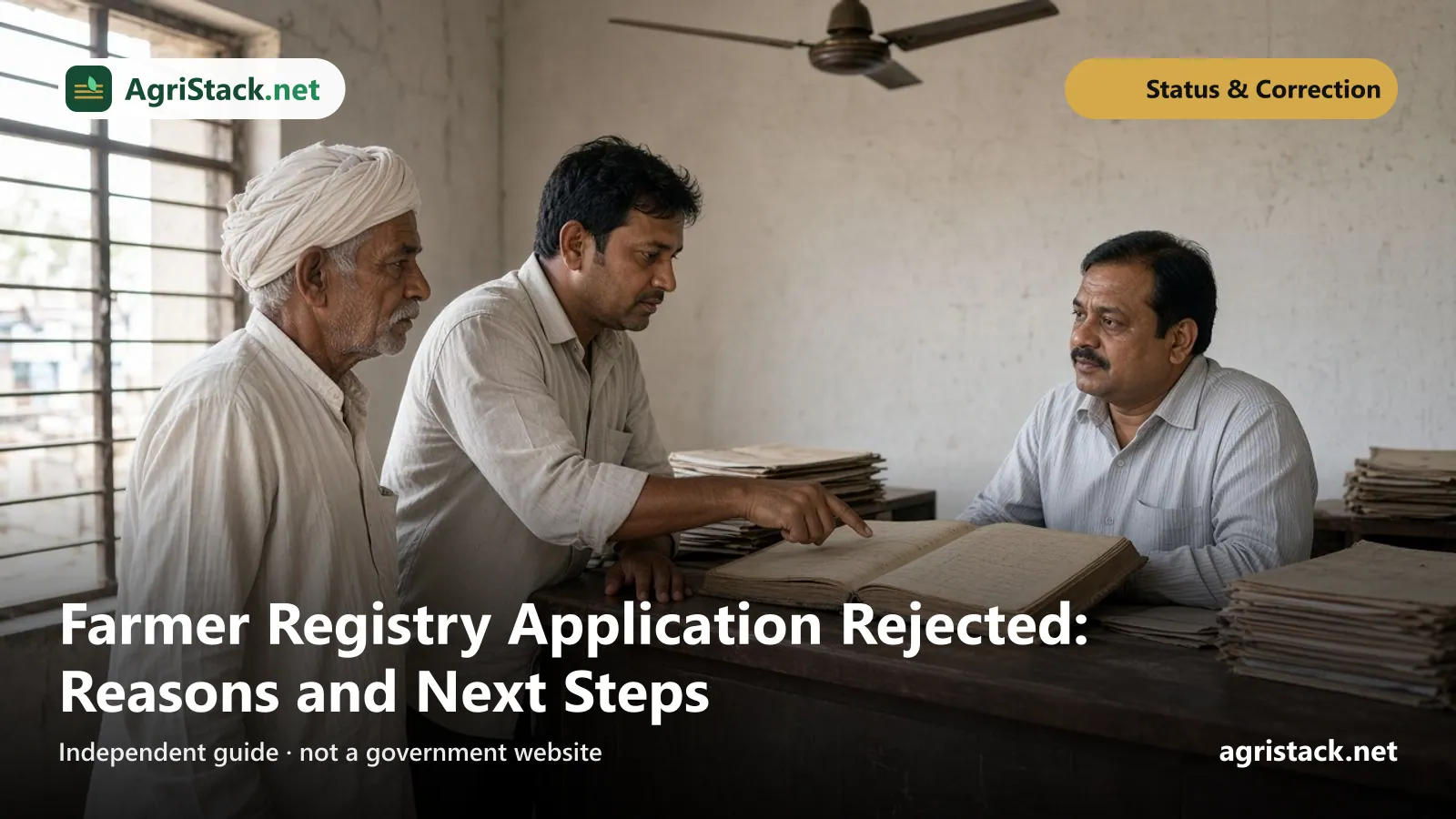
Most Farmer Registry rejections happen because the land record does not support the claim: either the names do not match closely enough, or the land is not recorded in your name. The official FAQ lists four common reasons. Each one has a different fix, and for three of the four, the fix is at the revenue office, not on the Farmer Registry portal.
This guide helps you work out which reason applies to you, then explains the right next step. Applying again without fixing the cause usually leads to the same result.
The official FAQ says the registry is built “strictly as per ROR”, the record of rights. An official cannot approve a claim that the land record does not support. Fix the record, and the claim can succeed.
The official reasons for rejection
The FAQ says land claims “are commonly rejected for the following reasons”:
- The name in Aadhaar and the name in the land records “do not match sufficiently although both are same names of the farmer differing slightly”.
- “The land is not in the farmers name in the land records.”
- “The owner has passed away, but the land records have not been updated (mutation has not occurred).”
- “The Record of Rights still stands in name of seller and not in the name of buyer-farmer.”
It adds a fifth case: a claim “can also be rejected if the claim is by one farmer having identical name and fathers name with that of the actual owner who is different”.
In Uttar Pradesh there is also an automatic block. The state manual (in Hindi) says claims in the lowest name-match band, up to 15, are closed automatically and not allowed.
Checks that happen before an official sees your claim
The FAQ says that when you claim land, the system runs two checks:
- A name match “between his or her name as in Aadhaar and the name in the bucket”.
- A check that your records “still exist in RoR with the same owner’s name”.
“If either of the checks fail, the Farmer is asked to make the necessary fixes before submitting his or her claim.” After submission, the state can set “as many levels of approval as needed to minimize incorrect claims”, and can also configure auto-approval if officials do not act within a set time.
So a rejection usually comes from a person (a revenue official) looking at a claim that passed the automatic checks but did not convince them. That is why the land record is the place to look first.
Find your reason
| Look at your land record. What do you see? | Likely reason | Where the fix happens |
|---|---|---|
| Your name, but spelt differently or shortened | Name not matching enough | Revenue office or Aadhaar centre |
| Someone else’s name entirely | Land not in your name | Revenue office (transfer, mutation) |
| Your late parent’s or grandparent’s name | Mutation not done after death | Revenue office (succession mutation) |
| The seller’s name, though you bought the land | Mutation not done after sale | Revenue office (sale mutation) |
| Your name, but you claimed the wrong plot | Wrong land claimed | Claim the right survey number |
| Your name matches, but it is not your land | Same name, different person | Do not claim; this is someone else’s land |
Check the record on your state’s official land record site. See official land record portals.
Reason 1: Names do not match closely enough
How to tell
The land record shows you as the owner, but with initials, a missing surname, a different spelling, or a different father’s or husband’s name. The system scores both your name and your relation’s name. The FAQ says “Zero score means no match and 100 score means perfect match”, and states choose their own limits.
What to do
Decide which record is wrong:
- Land record wrong (for example, initials or a misspelling): apply to the tehsil or revenue office for a correction.
- Aadhaar wrong or out of date: update it at an official Aadhaar centre.
Do not change a correct Aadhaar to match a wrong land record. Aadhaar is used for banking and many other services. See name mismatch for worked examples.
Before you go
Ask the office which documents it accepts. In general, carry your Aadhaar, a copy of the current land record, and any document showing your correct name.
Reason 2: The land is not in your name
How to tell
The plot you claimed belongs to someone else in the record: a brother, an uncle, a neighbour, or the family member who manages the land.
What to do
You can only claim land that the record shows as yours. If you farm land owned by a relative:
- the owner can register and claim it themselves;
- if the land should be yours (for example, after a partition), get the partition or transfer recorded first;
- if you cultivate it as a tenant, see the tenant route below.
The FAQ describes a provision “to Authorize a beneficiary at Scheme level”, done by the owner, so that cultivators can get benefits “without having a need to declare tenancy”. It adds that the Farm ID stays with the owner. Ask your state agriculture office whether this is available.
Reason 3: The owner has died and mutation is not done
How to tell
The record still shows your father, mother, husband or grandparent, who has passed away.
What to do
Apply for succession mutation at the revenue office. The FAQ says the Farm ID stays with “the CURRENT owner as per ROR”, even if that person has died, and that the state can bring legal heirs into the registry. In Parliament, the Ministry has said land records for “inheritance and land transactions are updated by the respective State Governments”.
Once the heirs’ names are recorded, each heir can claim. The FAQ says that if several heirs are brought in against the dead owner, “all of them will be assigned with same farm ID”. See inherited land and land mutation.
If someone else claimed a late relative’s land
The FAQ says if an unrelated person tries to claim a dead person’s land, “the name match score will be low/very low, such cases will go for approval of the authority and there they would be rejected”.
Reason 4: You bought the land but the record shows the seller
How to tell
You have a registered sale deed, but the online record still shows the seller’s name.
What to do
The sale needs to be mutated into your name at the revenue office. A registered deed alone does not update the land record in most states. Once the mutation is approved and the record shows your name, claim the land again.
The FAQ explains why the official rejected the claim: a patwari who knows a mutation has happened “will disallow the claim” by the old owner, and land claims follow the current record.
Reason 5: Same name, different person
How to tell
You found a plot in your village with exactly your name and your father’s name, but you do not own it.
What to do
Do not claim it. The FAQ says this is the only way a false claim can happen, and “the revenue official can reject the claim”. If a claim like this was approved by mistake, it is fixed through an “Update Farmer Request”. If someone else has claimed your land this way, raise a grievance.
Uttar Pradesh: the automatic block
In Uttar Pradesh, a score of 15 or below is blocked at once and never reaches an official. This usually means the names are completely different, or you selected the wrong owner in the list. Check that you chose your own name from the owner list, and that the land is really in your name.
Can you apply again?
After fixing the cause
Once the record is corrected or the mutation is done, the claim can succeed. How you submit again depends on your state. Some portals let you claim again; others want an update to the existing application. Ask the help desk which applies. Keep your old enrolment number; it helps the help desk find your history.
Without fixing the cause
Submitting the same claim again usually gives the same result. It can also create a duplicate record.
Appeals and grievances
Appeals
The FAQ says: “The process needs to be determined by the State, as the approval and rejection are done by the State officials.” There is no single national appeal form.
Grievances
The FAQ says the registry “would have a grievance raising module”, and a farmer “would raise the grievance there and would get a number”. It also says grievances on land claims are expected to be handled “within 10/15 days”. In March 2026, the Ministry told Parliament that “a grievance mechanism is in place through which farmers can raise issues related to land or name mismatch which enables them to register for Farmer ID”.
A grievance is the right route when you believe the rejection was a mistake, for example when your name and land record clearly match.

- Read the rejection reason if your state's portal shows one.
- Check your land record and compare it with your Aadhaar.
- Fix the record if it is wrong. Revenue office for land records; Aadhaar centre for Aadhaar.
- Raise a grievance if the rejection looks wrong. Keep the grievance number.
- Ask the help desk how to submit again once the cause is fixed.
When someone else’s claim was wrongly approved
The opposite problem also happens: your land was approved for another person. The FAQ says that where land was wrongly claimed and approved, the farmer “should approach the agristack authorities who would delink such bucket from him after necessary verifications”. If your land has been linked to someone else, raise a grievance and take your land record to the tehsil.
A rejection does not affect ownership
The FAQ says “the farmer registry is not a legal registry for the ownership purpose and it is only for the purpose of services and benefits”. A rejected claim does not take your land away, and an approved claim does not give anyone ownership. Ownership is decided by the land record and the revenue department.
Example: rejected, then approved
Kamla’s claim was rejected. Her land record still showed her late husband as owner.
- She checked the land record online and saw her husband’s name.
- She applied for succession mutation at the tehsil with the death certificate and the documents the office asked for.
- After the mutation was approved, the record showed Kamla and her two sons as owners.
- She asked the help desk how to submit again, then claimed the land.
- Her name matched closely, and the claim was approved.
(Example only. Mutation steps and documents vary by state.)
Tenant farmers and sharecroppers
If you farm land you do not own, a claim as owner will be rejected. In February 2025, the Ministry told Parliament that the registry application “has the provision to onboard the tenant and lessee farmers” and that a “State can decide to include such farmers in the Farmers Registry as per the State policy”. See tenant farmers.
Rejection and PM-KISAN
For new PM-KISAN registrations, the Ministry said in March 2026 that the Farmer ID is mandatory “in 19 States where farmer registry work has been commenced”. A rejected Farmer Registry claim can therefore hold up a new PM-KISAN application in those states. If you are already a PM-KISAN beneficiary, check your PM-KISAN status on the official portal rather than assuming. See Farmer ID and PM-KISAN.
What not to do
- Do not pay agents who promise to “reverse” a rejection.
- Do not claim a relative’s land to get approved.
- Do not change your Aadhaar name to match a wrong land record.
- Do not share OTPs with anyone who calls about your rejection.
For CSC operators
- Before submitting, look at the land record with the farmer and confirm their name is on it.
- If the land is in a dead parent’s name, stop and explain mutation rather than submitting.
- If a farmer comes back after a rejection, find out the reason first. Do not resubmit the same claim.