In the Farmer Registry, every co-owner of jointly held land registers separately with their own Aadhaar and gets their own Farmer ID. The shared plot is then linked to each of them. Women whose names are in the land record register exactly like any other owner: government statements say the registry covers all landholding farmers, including women.
The harder cases are when a woman farms land that is not yet in her name: land inherited but not mutated, land in her husband’s name, or a name that changed after marriage. This guide explains how the registry treats joint land, the steps for each co-owner, and what women farmers can check before registering.
This guide explains how the Farmer Registry reads land records. Who owns land, and how a name is added to a record, is decided by state revenue laws, succession laws and courts. For your own situation, speak to the revenue office or a lawyer. Free legal aid is available to women (see the end of this guide).
How the registry sees joint land
The Farmer Registry does not decide who owns land. It reads the state’s record of rights and links each person to the land recorded in their name. The official FAQ says the registry “is not a legal registry for the ownership purpose and it is only for the purpose of services and benefits”.
Three numbers matter here:
- Survey number: the plot in the land record. See survey number explained.
- Farm ID: the official FAQ defines it as “the extent owned by one ownership” within a plot.
- Farmer ID: your own ID, linked to all the Farm IDs you own or co-own.
Joint owners and separate owners
The FAQ makes an important distinction. Joint owners hold the whole plot together, without separate shares written in the record. Separate owners each have their own share recorded. As the FAQ puts it, “if the owners had their own share then they would not be called joint owners”.
| How the record shows the plot | Farm IDs created | What each owner gets |
|---|---|---|
| One owner | One | That owner’s Farmer ID links to it |
| Several owners, each with a recorded share | One per owner | Each owner’s Farmer ID links to their own Farm ID |
| Several joint owners, no shares | One for the group | Every joint owner’s Farmer ID links to the same Farm ID |
| A mix of joint groups and single owners | One per group or owner | Each group or owner gets its own Farm ID |
The FAQ’s example: survey number 121/1
The official FAQ gives an example of a 5-hectare plot, survey number 121/1, with six owners named A to F:
- If each of the six has a recorded share (for example A has 1 hectare, B has 1.5 hectares and so on), six Farm IDs are created, one for each owner.
- If all six hold it jointly, one Farm ID is created and all six are assigned the same Farm ID.
- If A, B and C are joint, D is single, and E and F are joint, three Farm IDs are created: one for A, B and C together, one for D, and one for E and F together.
So the number of Farm IDs depends entirely on how your state’s record shows the shares. You do not choose it when you register.
Buckets: how each co-owner finds the land
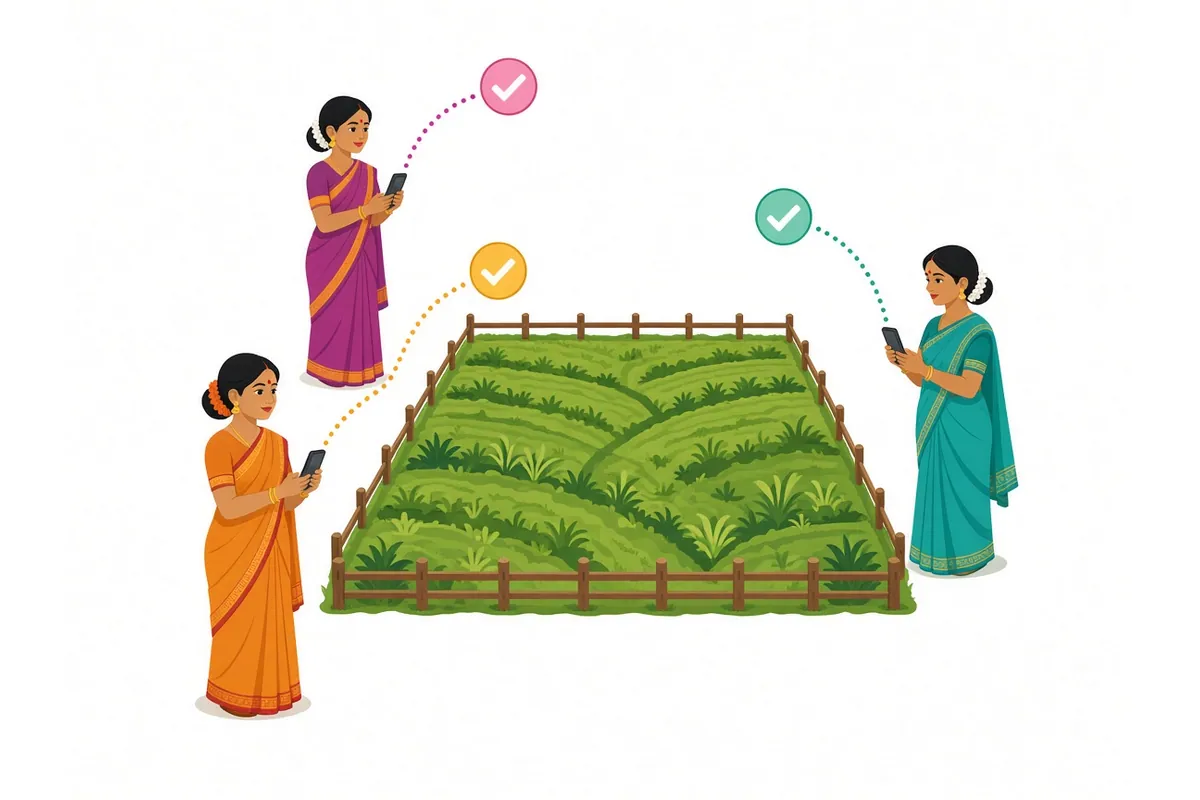
Before registration opens, the land in each village is grouped into “buckets” for each owner, based on the owner’s name and their father’s or husband’s name in the record. The FAQ says that if there are four joint owners, “4 buckets would be there and in each bucket that farm ID would be contained”, and that “Any farmer can claim that bucket”.
In plain terms: the jointly owned plot appears in each co-owner’s own list of land. When you register, you claim your bucket. Your co-owners claim theirs separately.
Registering as a co-owner: step by step
- Check the land record. Open your state's land record site and confirm your name appears as an owner or co-owner. See official land record portals.
- Note how your name and your father's or husband's name are written. The registry compares these with your Aadhaar details.
- Register with your own Aadhaar and your own mobile number linked to Aadhaar, on your state's Farmer Registry portal, through the Kisan app where your state offers it, or at a camp or CSC.
- Look for the jointly owned plot in the land shown to you. If it is missing, search by district, sub-district, village, survey number and sub-survey number.
- Claim it and submit. If the name-match score is low, the claim goes to a revenue official for approval.
- Tell your co-owners to register for themselves. Your registration does not register them.
What each co-owner needs
- Their own Aadhaar, and a mobile number linked to it for OTP.
- The plot details from the current land record.
- Their name in the land record, written closely enough to their Aadhaar name.
You cannot register on behalf of a co-owner, even a close relative. Each person completes their own Aadhaar authentication. See CSC guide for registering with help.
When only some co-owners register
Nothing stops you registering if your brother, sister or mother has not. Each co-owner’s bucket is separate. Co-owners who have not registered simply do not have a Farmer ID yet, and the plot appears in their bucket when they do.
Co-owners who live elsewhere
A co-owner who has moved to a city or another state still registers in the state where the land is recorded, with their own Aadhaar. The official FAQ says a farmer has one Farmer ID even with land in more than one state. See multiple land plots.
Women farmers and the Farmer Registry
Women are covered
In replies to Parliament, the Ministry of Agriculture has said the Farmer Registry covers all landholding farmers, including women farmers. A government backgrounder published in February 2026 said that as of 27 November 2025, over 7.63 crore Farmer IDs had been generated, “including 1.93 crore IDs for women farmers”.
A woman whose name is in the land record follows the same steps as anyone else. There is no separate form for women.
Name problems common for women
Name differences are the most common reason a claim is sent for manual checking. Some situations come up often for women.
Name changed after marriage
If the land record shows a maiden name and Aadhaar shows a married name (or the other way round), the two may not match well. Options include updating Aadhaar or applying to correct the land record, depending on which is wrong. See name mismatch and Farmer ID correction.
Father’s name or husband’s name
The official FAQ says land records store the owner’s “identifier”, which may be the father’s, husband’s or guardian’s name, and that the name match checks the farmer’s name and this relation’s name. A woman may be recorded with her father’s name in one record and her husband’s in another. Note which name your land record uses and tell the operator or official if your other records differ.
Initials and spellings
Records may show initials, a surname only after marriage, or a different spelling in the local script. Small differences are usually handled by the name-match score; large ones go to an official.
Women who farm land not in their name
Many women farm land that is recorded in someone else’s name. The registry links land from the record of rights, so you can only claim land as an owner once your name is in that record.
Inherited land not yet mutated
If a father, mother or husband has died and the land is still in their name, the FAQ says the Farm ID stays with “the CURRENT owner as per ROR”. The heirs need mutation (also called dakhil kharij, varasat, ferfar or similar) at the revenue office. Once heirs are recorded, the FAQ says that if several legal heirs are brought into the registry against the dead owner, “all of them will be assigned with same farm ID”. The Ministry has also told Parliament that land records for “inheritance and land transactions are updated by the respective State Governments”. See inherited land and land mutation.
Daughters’ inheritance rights
For Hindus (which in succession law also covers Sikhs, Jains and Buddhists), the Hindu Succession (Amendment) Act, 2005 made a daughter a coparcener by birth with “the same rights in the coparcenary property as she would have had if she had been a son”. The amendment also removed a provision that had kept agricultural land tenure laws outside the Act.
This is not the whole picture. How the amendment applies to agricultural land, especially for deaths before it came into force, and how it interacts with state land laws, has been considered by the courts. Other communities follow their own succession laws. Get advice for your own case before assuming your share.
Land in a husband’s name
If land is held in a husband’s name, the registry links it only to him. Adding a wife’s name normally needs a lawful transfer such as a gift or partition, registered under state law and followed by mutation. Stamp duty and procedure differ by state. Ask the sub-registrar or revenue office.
Tenant and sharecropping route
The Ministry has told Parliament that there is a provision to onboard tenant farmers and sharecroppers, depending on state policy. If you cultivate land on lease or as a sharecropper, check whether your state has opened this. See tenant farmers.
Common joint-land problems and what to do
| Problem | Likely reason | What to do |
|---|---|---|
| Jointly owned plot not shown | Name in record differs a lot from Aadhaar | Search manually by survey number; if found, claim it for official review |
| Plot shown but share looks wrong | Shares in the land record are wrong | Correction at the revenue office; the registry follows the record |
| Co-owner’s land shows in your list | Same name and father’s or husband’s name in that village | Do not claim it. See below |
| Land still in late parent’s name | Mutation not done | Apply for mutation first |
| Woman’s claim sent to official | Maiden or married name difference | Wait for review; correct the record if needed |
| Co-owner abroad or unwell | Cannot authenticate | They register when they can; it does not block you |
If someone claimed your share by mistake
The FAQ says a wrong claim can only happen when another person in the village has “the exact name and Father’s / husband’s name”. The revenue official can reject such a claim. If it was approved by mistake, it is fixed through an “Update Farmer Request”. Contact the official named in your state’s grievance process, and keep your land record copy ready. See Farmer Registry helpline.
Questions to ask at the revenue office
If your situation is complicated, these questions help:
- Is my name recorded as an owner or co-owner of this survey number?
- Is the plot held jointly, or are shares recorded?
- Is any mutation pending for this plot?
- Is my name spelt the same as on my Aadhaar? If not, how is it corrected?
- Does this state allow tenants or cultivators in the Farmer Registry?
For CSC operators
- Register each co-owner separately, with their own Aadhaar and OTP. Never use one co-owner’s details for another.
- Before claiming, confirm the farmer’s own name is in the owner list for the plot.
- Do not claim land that belongs to someone else with a similar name.
- For women farmers, check whether the record uses the father’s or husband’s name, and whether the name changed after marriage.
- If land is still in a dead owner’s name, explain the mutation route rather than registering the heir against it.
Free legal help for women
Under section 12 of the Legal Services Authorities Act, 1987, women are among the people entitled to free legal services. Contact your District Legal Services Authority, usually at the district court, or the National Legal Services Authority. They can advise on inheritance, partition and land record disputes.