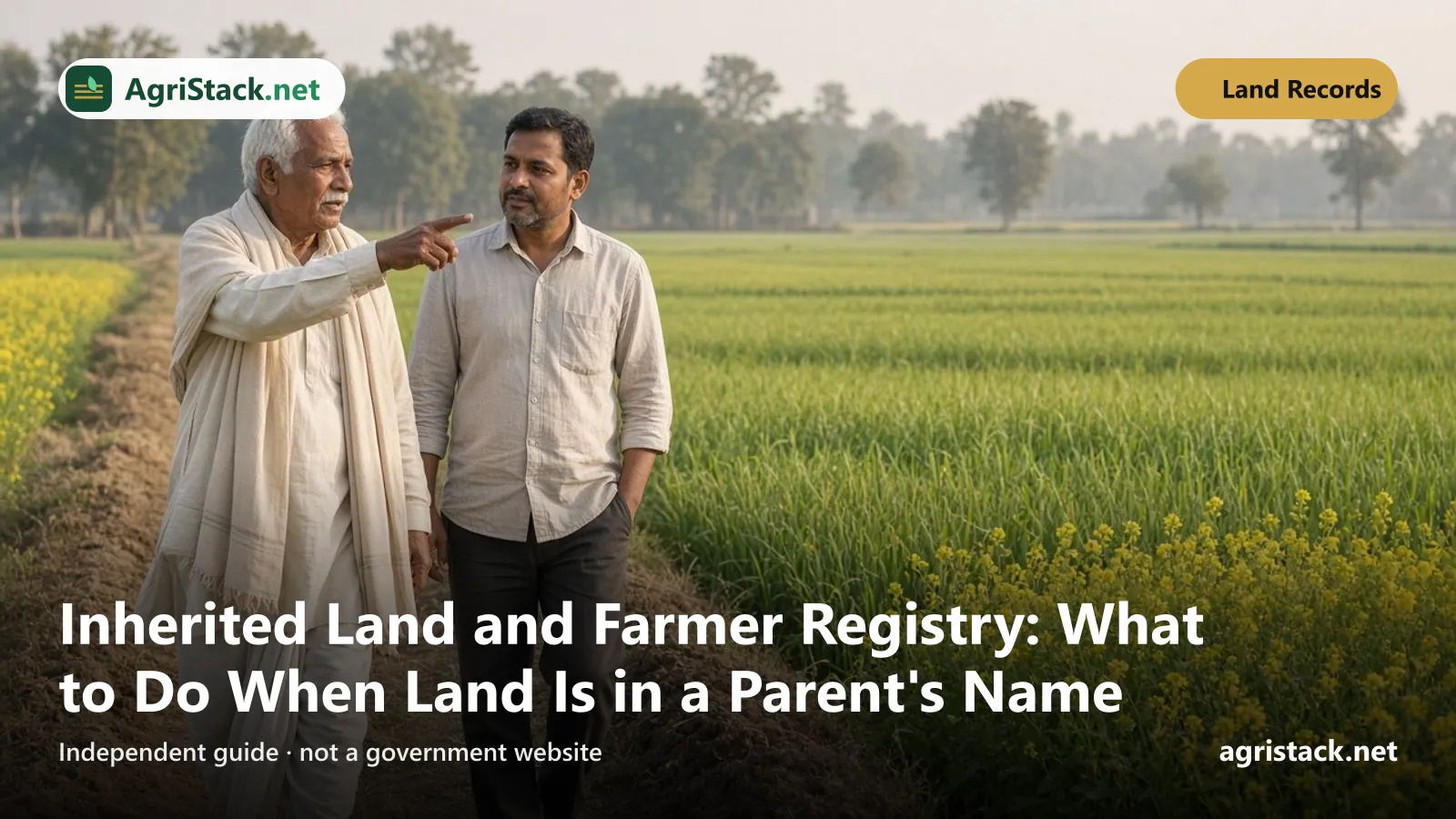
If your land is still recorded in the name of a parent or grandparent who has died, the Farmer Registry will normally show the land under their name, not yours. You can still register as a farmer, but you cannot claim that land as your own until the land record is updated through a succession mutation, unless your state has a special process for legal heirs.
This is one of the most common reasons land claims are rejected. This guide explains why, what the official rules say, and the practical steps to fix it.
The Farmer Registry cannot transfer land between family members. Only the state revenue department can do that, through mutation. The registry then follows the updated record.
Why the registry shows a dead owner’s name
The registry is built from your state’s record of rights (RoR). The official AgriStack FAQ says the Farm ID (the ID of a piece of land) is created “as per ROR”, and “That farm id would have the CURRENT owner as per ROR”.
It also says plainly that whether the owner is alive is not considered at this stage: “If the owner is dead then also the farm ID continues to be shown against him/her because that is the name which is present in the record of rights.”
So if your father died and the land record was never updated, the system still sees your father as the owner.
What happens if you try to claim it anyway
When you search for the plot and select the owner’s name, the system compares your Aadhaar name with the owner’s name and the father’s name. Your name and your father’s name are different, so the score will be low.
The FAQ explains: if someone other than the recorded owner tries to claim a dead person’s land, “the name match score will be low/very low, such cases will go for approval of the authority and there they would be rejected.”
Among the main rejection reasons listed in the FAQ is: “The owner has passed away, but the land records have not been updated (mutation has not occurred) and stand in name of dead person and not the farmer.”
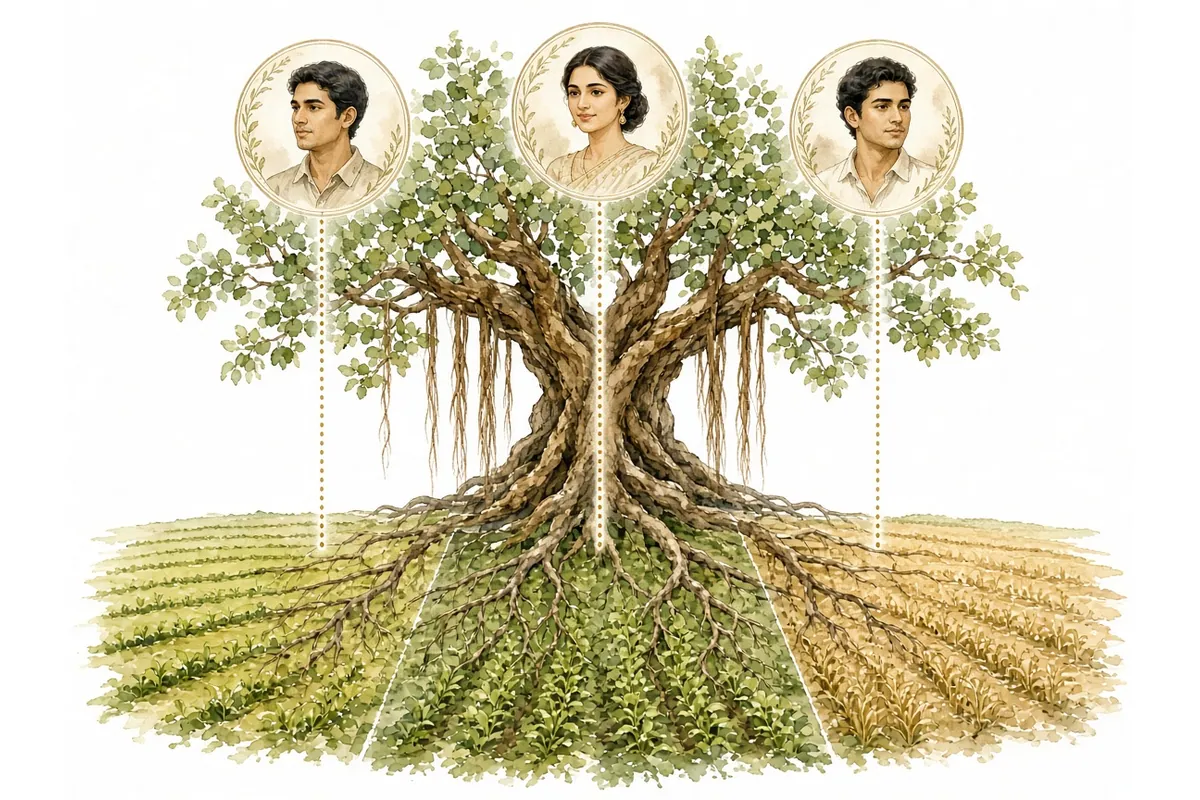
The usual fix: succession mutation
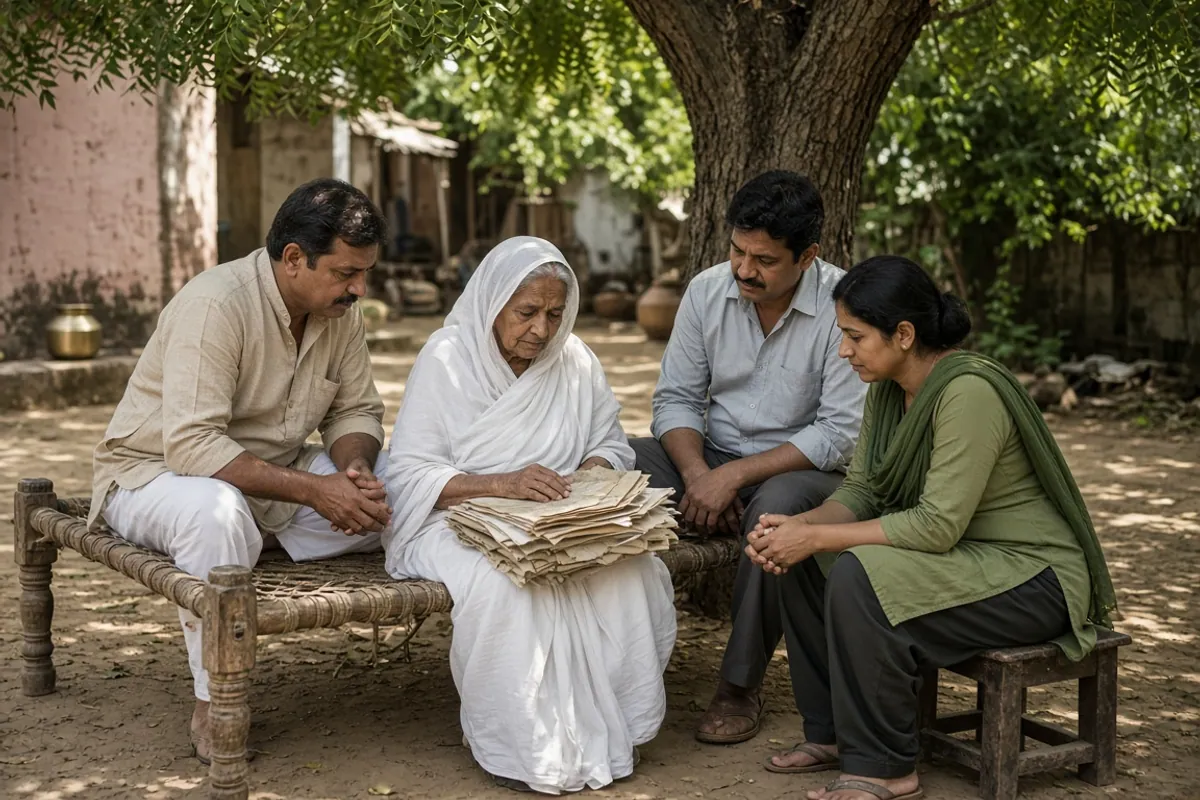
A succession mutation (also called inheritance mutation; local terms include varasat in Uttar Pradesh, dakhil-kharij for mutation in Bihar and ferfar for mutation entries in Maharashtra and Gujarat) updates the land record to show the legal heirs as owners.
The exact process, forms, fees and time limits are set by each state’s land revenue law. In general:
- Get the death certificate of the recorded owner.
- Identify all legal heirs. Many states require details of all heirs, not just the one applying.
- Apply at the tehsil, revenue office or state online land services portal. Some states allow online applications.
- Verification by the village revenue official (Patwari, Lekhpal, Talathi, VAO or equivalent), often with a public notice for objections.
- Order and record update. The new owners appear in the land record.
- Claim the land in the Farmer Registry as the new owner, or update your existing Farmer Registry record.
Ask at your tehsil or check your state’s revenue department website for the exact documents. See our guide to land mutation and Farmer Registry and the list of official state land record portals.
The legal heir provision: a state decision
The FAQ describes a possible shortcut, but makes it a state choice:
- “After farmer registry is formed, state can decide whether they would like to bring legal heirs in farmers registry pending updating to ROR.”
- “There would be a mechanism to replace the name of the dead farmer by his legal heir. At that time, the farm ID would then be linked to the legal heir as are brought into the farmer registry with the approval of Government officials.”
- “In case, multiple legal heirs are brought into the farmer registry against that dead person then all of them will be assigned with same farm ID.”
This means some states may let heirs be added before the mutation is complete, with an official’s approval. Others may require the mutation first. We have not found an official national list of which states allow this. Ask your agriculture office or state help desk before relying on it, and treat it as a temporary measure: the land record should still be updated.
If you inherited land after you already had a Farmer ID
If you already registered with your own land, and later inherit more:
- Complete the succession mutation so the land record shows you.
- Use the update option on your state portal to add the new land. The UP manual describes this as “Update My Information”, then ”+ Add New Land (Owned)”. The national FAQ calls it the Update Farmer Request (UFR).
- The new claim goes through the same name-match and approval checks.
In states where the registry is electronically linked to land records, the FAQ says later mutations “would automatically move” land between farmers in the registry. Even so, check your profile after the mutation to confirm the land appears.
What happens to the deceased farmer’s Farmer ID
If your parent had a Farmer ID, the FAQ says:
- “The farmer ID would be inactivated after the farmer dies.”
- “The farm ID would remain the same and would now be linked to the successor of the dead farmer.”
- “If multiple people get portion of the land then the farm ID will be inactivated and multiple farm IDs would be generated depending upon the number of pieces of land created by the family.”
In short, the person’s ID ends and the land’s ID continues with the new owner, unless the land is divided.
For the difference between these numbers, see Farm ID, Farmer ID and Land ID.
Inherited land shared by several heirs
How the registry handles shared inheritance depends on how the land record is updated:
| Land record after mutation | Farm IDs | Who can claim |
|---|---|---|
| All heirs as joint owners, no separate shares | One Farm ID | Each heir can claim the same Farm ID |
| Each heir’s share recorded separately with an area | One Farm ID per owner’s share | Each heir claims their own share |
| Land physically partitioned into new plots | New Farm IDs for new pieces | Each owner claims their plot |
This follows the FAQ’s explanation of joint ownership: one jointly owned plot “without any share” has one Farm ID, while owners with separate shares are treated as separate owners. See joint land and women farmers, which matters especially for daughters and widows who inherit.
While the mutation is pending
Mutation can take time. In the meantime:
- Register yourself anyway if you have other land in your name. You can add the inherited land later.
- Ask about the legal-heir provision in your state.
- Ask about scheme-level authorisation. The FAQ mentions a provision for land owners to authorise a beneficiary at scheme level, so that the person cultivating can receive benefits. How this works depends on the scheme and state.
- Keep copies of the death certificate, mutation application and receipt.
Documents commonly asked for in succession mutation
Each state sets its own list, so treat this as a list to ask about, not a fixed requirement. Offices commonly ask for:
- the death certificate of the recorded owner;
- identity proof of the applicant and, often, of other heirs;
- a family tree or list of legal heirs, sometimes verified locally or supported by an affidavit;
- a copy of the current land record for each plot;
- if there is a will, a copy of it, which may involve a different process;
- if heirs have agreed to divide the land, a partition or family settlement document, where the state accepts one.
Some states take succession applications online through their land services portal; others need a visit to the tehsil. Ask before you go so you make one trip, not three.
Questions to ask at the tehsil or revenue office
- Which form do I use for succession mutation, and can I apply online?
- Which documents do I need, and do all heirs have to sign or appear?
- How long does the notice period for objections last?
- Is there a fee?
- When the record is updated, how do I get a copy showing the new owners?
- Does the update reach the Farmer Registry automatically in this state, or must I add the land myself?
Situations that need extra care
Daughters and widows. In many families, land passes informally to sons, and daughters or widows are not added to the record. Who inherits depends on the personal law that applies to the family and, for agricultural land in some states, on state land laws. If you are a legal heir and your name is missing from a mutation, raise it with the revenue office before the record is finalised. Being recorded as an owner matters for the Farmer Registry and for schemes that rely on it. See joint land and women farmers.
Heirs living elsewhere. If some heirs live in another district or state, mutation can take longer because their consent or details may be needed. Start early.
Disputes. If heirs disagree, the revenue office or a court must decide. The Farmer Registry cannot resolve a dispute and will only follow the final land record. The official FAQ mentions that states may provide for allotting Farm IDs “in case of death or dispute pending updating in RoR”, but how this works, if at all, is up to each state.
Very old records. Sometimes land is still recorded in a grandparent’s name, and several generations have not been updated. This can require multiple steps. Ask the revenue office to explain the order.
For CSC operators
- If the plot is in a deceased person’s name, do not submit a claim for it under the heir’s Aadhaar. Explain that it will very likely be rejected.
- Register the farmer with any land already in their own name, and tell them they can add inherited land later.
- Give them the questions above to take to the tehsil.
- Tell them to check whether your state allows legal heirs to be added before mutation, and where to ask.
Common mistakes
- Claiming the land under your parent’s name. It will score low and be rejected, and may delay other claims.
- Assuming a will or family agreement is enough. The registry reads only the land record. Until the record changes, the registry does not.
- Leaving out other heirs. Mutation usually needs all legal heirs. Disputes among heirs can block it.
- Paying an agent to “add inherited land” in the portal. Nobody can bypass the land record in the registry.
Who to contact
| Question | Contact |
|---|---|
| Starting succession mutation | Tehsil, revenue office or village revenue official |
| Whether legal heirs can be added before mutation | District agriculture office or state Farmer Registry help desk |
| Adding land after mutation | State portal (update option), CSC or agriculture office |
| Dispute among heirs | Revenue court or legal advice; the registry cannot decide disputes |